



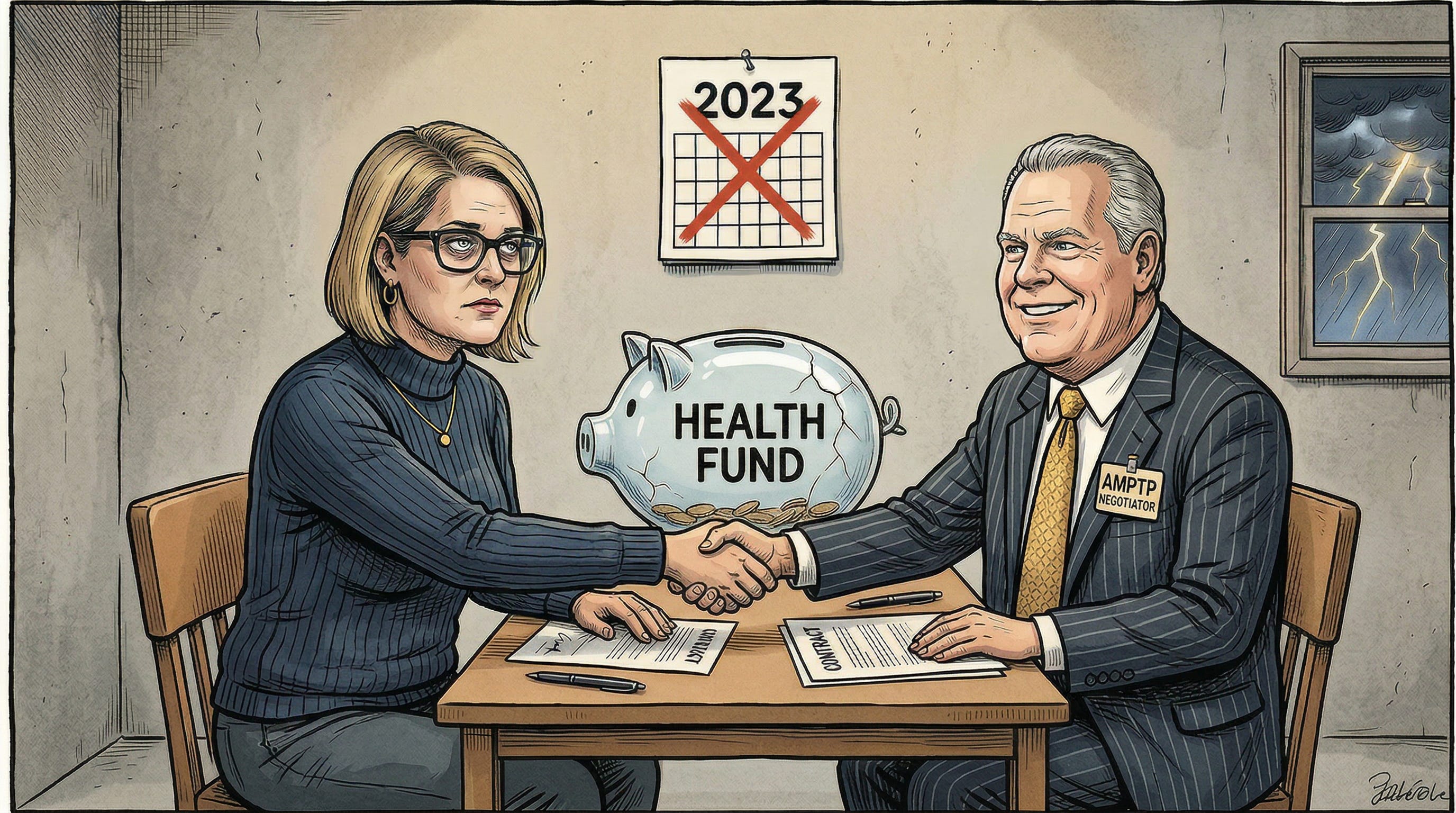
In the hours following Saturday’s surprise announcement — which arrived nearly two months before the WGA’s hard-fought 2023–26 collective bargaining agreement was set to expire, on May 30 — that the WGA and AMPTP had reached a tentative deal on a new union contract, I saw two reactions that struck me as especially representative of how the unexpected news was being received around town.
The first was a text message I received at 4:28 p.m. on Saturday, from a close friend in a senior business affairs position at a major studio, who observed, “Our labor guys haven’t emailed us so they must be getting blacked out drunk.”
The second was an anonymous comment on Deadline’s announcement, posted at 6:05 p.m. that day by someone calling themselves “WGA Member,” which asked “Why hasn’t the Guild notified members about this? Why am I finding this out from Deadline?”
What a difference three years can make.
Few people expected the 2026 collective bargaining season to be a repeat of the fire-and-brimstone “Hot Labor Summer” of 2023, during which overlapping WGA and SAG-AFTRA strikes paralyzed the industry for nearly four months.1 In a column I published in the Ankler a few days before the WGA’s full membership voted to ratify the new deal, I opined that, based on the deal’s final terms, the process of making it had been far longer and more painful than was necessary — not just for the writers, but for the industry as a whole. Because of that bungled process, I argued, the WGA had “spent two collective bargaining cycles’ worth of negotiating fuel” on the 2023 contract, and that “a still-financially and emotionally exhausted talent community will likely have little appetite for another major work stoppage” in 2026.
These views — already fairly common when I first published them in October 2023 — were largely incorporated into the prevailing “conventional wisdom” about the strike, as production volume and opportunities continued to decline industry-wide in the months that followed, and rank-and-file WGA members grew increasingly skeptical that the gains they achieved in 2023 had been worth the cost. They seemed even more prescient as, in the early months of 2026, rumors began to swirl that the WGA’s health fund, the financial wellspring of the guild’s much-celebrated health insurance plan for its members, was critically underfunded and at risk of imminent collapse without a major infusion of capital from the AMPTP, which quietly let it be known that it would be happy to oblige with a bailout — in exchange for a five-year term for the new deal, which would break decades of precedent for three-year renewals.
Still, I never thought (or heard anyone predict) that the first big piece of news to break about the WGA and AMPTP’s negotiations would be that the negotiations were already over.
Because details about the new deal (other than its four-year term) remain scarce, it’s too early to comment meaningfully about its substance, or about who “won” or “lost” in the process (not that various pundits and ideologues will be deterred from trying in the days ahead).
But there are already some valuable lessons we can draw from what we do know about this deal and how it was made and announced, and some interesting questions we can ask about what to expect (and not expect) as we learn more in the weeks ahead.
1. The WGA’s Health Fund Was Probably in Even Worse Shape Than We Thought
The experience of (and fallout from) the summer of 2023 certainly loomed large over the WGA and AMPTP’s negotiations for 2026. But I don’t think that context is enough, on its own, to explain this weekend’s surprise announcement. That includes, notably, the WGA’s consent to a template-breaking four-year term without any discernible show of public resistance — something that, I think, comes down to the factor that has dominated what little public discussion we’ve heard about these negotiations to date (even though it wasn’t on any of our radars three years ago): the looming insolvency of the WGA’s health fund.
The WGA’s “Cadillac” health plan has long been the envy of the other entertainment unions (whose own plans feature some combination of lesser benefits, greater members costs, higher income requirements, and tiered benefits at different income levels), as well as a thorn in the side of the AMPTP companies (many of whose executives have long regarded it as an unsustainable extravagance). Among other remarkable features of the WGA’s plan, members currently do not contribute anything from their own to pay toward their premiums; they only pay out of pocket to add eligible dependents to their plans. As the general unaffordability of health care has metastasized into a bona fide national crisis, the WGA’s health plan has stood out even more as one of the guild’s foremost achievements for its members. For most writers, there is perhaps no more potent or salient example of how the union has made their day-to-day lives better.2
In any era, that would make protecting the WGA health plan one of the union’s most crucial priorities. But this is not “any era” — this is an era that most writers would describe as one of systemic decline for their profession, defined by growing financial insecurity, deteriorating employment prospects, and the still-unresolved existential threat posed by generative AI.3 It’s also an era in which many WGA members have increasingly questioned whether their union’s signature initiatives of the last decade — not just the 2023 strike, but before that, the 2019–21 “Agency Campaign” that effectively ended the practice of agency packaging in scripted TV and drove the agencies out of the studio business — might have exacerbated rather than mitigated that systemic decline.
In this context, the collapse of the WGA’s health plan would not just have devastated its members — it would have inflicted a deep wound on the union’s credibility and effectiveness that could take a generation to heal. Both sides knew this, guaranteeing that negotiations would play out very differently in 2026 than they had in 2023. But the particular speed and quiet with which this deal was made suggests to me that the WGA knew that its health fund was in even more precarious condition than most of us realized, had little to no leverage to secure much of anything beyond the recapitalization of the fund, and understood that an extended term would be the price (but perhaps a not unwelcome one in this ongoing era of turbulence and unpleasant transformation).
The collapse of the WGA's health plan would not just have devastated its members — it would have inflicted a deep wound on the union's credibility and effectiveness that could take a generation to heal.
2. It Helps to Have the Right People Sitting at the Negotiating Table
A lot of attention will be paid to the “speed” part of that last sentence, but I’m actually more interested in the “quiet.”
One could gently characterize the WGA’s style over the last decade as “pugnaciously adversarial.” Or, one could less gently characterize it as “constantly spoiling for a fight.” Not that I would give high marks to the AMPTP either, with its apparent focus on minimizing concessions rather than reaching meaningful understandings. The organizations coming back to the table in 2026 are the same ones that mucked it up so badly last time (and frankly didn’t have a great track record before then either).
But they aren’t all the same people that were at the table last time, and that counts for a lot. I haven’t personally paid attention to labor relations long enough to know whether the AMPTP’s Carol Lombardini or WGA’s David Goodman were at one point strategic or effective as negotiators, but suffice it to say that neither is missed by the institutions they once faced (nor, as far as I can tell, do they seem to be much missed by their own old organizations).4
The AMPTP’s negotiating team is now led by Greg Hessinger, a respected labor lawyer and former CEO of SAG (pre-AFTRA), who has worked to rebuild the kind of collaborative and trust-based process with the WGA that was absent from Lombardini’s later years. On the other side returns the WGA’s chief negotiator, Ellen Stutzman, now free of Goodman’s often inflammatory and corrosive influence, and obviously receptive to (and probably pretty refreshed by) the change in the AMPTP’s approach and tone.
It’s amazing what people can accomplish when they actually talk to each other and engage on the underlying substance of shared problems, with a mutually-held realistic understanding of prevailing circumstances and a shared commitment to working things out without further disrupting an already fragile industry. Rather than, for example, scornfully and performatively sassing one another from a distance according to their respective constructed narratives, fueled by a decade or more of scarcely forgiven and certainly not forgotten slights (real and perceived).
3. Negotiating in Public Should Be Your Last Resort, Not Your First
The distinguishing feature of the WGA’s 2026 deal is not merely the absence of apparent conflict, but the absence of public discussion altogether. That’s because this deal was negotiated where it belongs: in private.
Several of the last collective bargaining cycles opened with some perfunctory initial “negotiations” that seemed intended to quickly stall, followed by far more protracted public and semi-public lobbying of constituents to build (and demonstrate) solidarity for an adversarial process ahead. The people running the WGA would say it was necessary to muster the member awareness, sentiment, and solidarity required to negotiate with leverage. The people at the AMPTP would say the WGA started it. I’d say it reflects both sides’ total lack of seriousness in those years about just making a deal (rather than putting on a show).
For the 2026 negotiations, both the AMPTP and the WGA deployed the most effective public communications strategy possible: none at all.
That’s not to say that collective bargaining should never be carried out in the press, or that the WGA’s argument about the necessity of at least member-facing communications is without merit. But the press is a forum for the debate of conflicts that have defied resolution in the negotiating room. Communication with members (and some measure of transparency) is important, but so is a negotiator’s ability to maintain confidences, build quiet consensus, and represent their constituency’s position with clear and confident authority.
Negotiating in the press and publicly rallying the troops are part of the collective bargaining process, and always will be. But they’re not usually a sign that it’s going very well. And as Saturday showed, when the parties are serious about making a deal, they don’t have to be part of the process at all.
4. So Are We Actually Going to Do Something About This Health Fund Problem?
I know this article starts with the premise that doing something about this health fund problem is what this whole deal is pretty much about. And with a contribution likely well into the nine figures, I’m certainly not minimizing what the AMPTP is doing (and what the WGA is getting) to restore the health fund to solvency.
But it’s going to deplete again.
If there’s a plan for how to preserve the solvency of the plan well into the future, consider me surprised, pleased, and eager to hear about it. The WGA regularly diverts increases to scale minimums, which would be immediately felt in its members’ pockets, for the benefit of its pension and health plans. That’s smart, responsible decision-making, and I’m sure it will continue. Writing employment numbers will probably stabilize and may even tick upward, and the steady climb in scale minimums will float a lot of boats.
But the WGA’s health insurance plan is probably just too good for a world as flawed as ours. It’s not in duress because of the pandemic or tariffs or energy costs or any number of other macroeconomic factors. It’s in duress because, as the WGA’s plan is currently built, too many members take too much money out of the system for how much money goes into it. It’s as simple as that.
Letting the health fund fail (and the chips fall chaotically where they may) would be an unnecessary and self-inflicted catastrophe. Recapitalizing it without addressing the underlying structural problems merely defers the crisis. And we’ve yet to see how durable this newfound goodwill will prove to be.
Which brings us back to the same old list of ugly-sounding “reforms”: increasing eligibility requirements, increasing deductibles and co-payments, decreasing benefits, or increasing premiums. They all suck. So do a lot of things right now.
It would be a waste of this rare moment of apparent labor relations harmony (and of the giant check about to be cut by the studios) not to engage in serious and open-minded discussion about at least incremental changes in the structure and economics of the WGA’s health benefits.
At a minimum, it seems obvious that the WGA will need to adopt a version of the DGA’s tiered benefits. Directors with at least $41,215 in DGA-covered earnings for the year qualify for the DGA Choice Plan, while those earning at least $133,670 get the DGA Premier Choice Plan (which offers lower out-of-pocket maximums and better coverage for non-network providers). In addition, WGA members will likely have to start contributing something from their own pay toward premiums/costs, something that SAG-AFTRA members already have to do for their insurance, currently considered the weakest of the plans for the three major guilds (whereas WGA and DGA members currently only pay out-of-pocket to add dependents to their coverage). I have neither the data nor the actuarial skills to say this with any certainty, but I suspect those two tweaks alone would make a huge dent in the problem, and the need for (and scale of) other changes could be evaluated from there.
5. Is Four Years the New Three Years?
If you know anything about collective bargaining in the entertainment industry, your first thought upon hearing this deal (after “huh, already?”) was probably “Are SAG-AFTRA and the DGA going to agree to four years now?”5
I’m guessing yes. And I’m all for it.
The guilds have long resented the way the AMPTP tends to treat whatever major conceptual ground is broken in the first closed agreement of each triennial collective bargaining season — typically with the DGA — as both floor and ceiling for each deal that follows. Relatedly, SAG-AFTRA and the WGA have long resented the DGA’s focus on creative rights (and continuing its exclusive hold over the coveted “film by” credit), its apparent coziness with and amiability toward the studios, and the way that the structure of directing compensation has largely insulated its members from much of the squeeze felt by writers and actors as a result of changes in production norms during the streaming era.
But they wouldn’t resent it if it didn’t work, and the AMPTP will surely insist that although — or even because — the norm of three-year terms has been broken, the norm of aligning all three major union contracts on the same negotiating cadence must be respected.
Even so, I don’t think it’s just a precedent-and-leverage game here. The WGA got something extraordinary in exchange for opening the door to a four-year deal, and SAG-AFTRA and the DGA will likely look for some signature wins uniquely relevant to their own members to tack onto the basic framework established by the WGA’s new contract. If the AMPTP’s handling of the WGA deal is any indication, they’ll probably get something to show for it too (and they should).
But negotiating dynamics aside, just looking back on the years we’ve just lived through (and forward to the years ahead), a little long-term certainty, security, and stability sounds pretty good right now. The world is still changing very fast, and an extra year will no doubt expose even more holes in the existing system that call out for further reform. But as I wrote in the early days of the 2023 strike, the central problem of every CBA negotiation is often the unintended consequence of how the parties solved the central problem of the last one.
Even without that track record, though, it would be foolish to believe that we really know what generative AI will do to the industry, or what that industry will look like when there is no one left who can merge with anyone else. And it would be downright deluded to think that we’re ready, today, to come up with ambitious, durable, and externality-free solutions to the business’s greatest problems.
An extra year to figure some of that out sounds pretty good right now.
This post is always free, one of a handful that will never go behind the paywall. Share it with anyone.
I hated that phrase “Hot Labor Summer” then, and I hate it now. As I wrote this, I realized I hadn’t even thought of it in nearly three years. Here’s hoping that, following this callback, I never will again.
Studios are regularly prevailed upon by agents and lawyers to advance fees or otherwise restructure agreements for writers to ensure they remain eligible to receive their union-provided health insurance. I’ve always viewed accommodating such requests as one of the most important ways a studio can curry favor with (and demonstrate some humanity and respect toward) the talent community.
According to the WGA’s own data, writer employment in 2024 was down 9.4% from 2023 (when the strikes shut down production for nearly one-third of the year), and down 24.3% from 2022 (when, based on production volume, the industry finally hit the “peak” in “peak TV”).
I have more detailed thoughts about the performance of the WGA and AMPTP and their leaders, as negotiators (and, in that capacity, as stewards of the industry), informed by my experience as one of several heads of business affairs representing dozens of AMPTP member companies (and affiliates) who consulted with Lombardini and the member companies’ lead labor relations executives concerning various provisions being negotiated for the 2020 Basic Agreement. But it would distract from the point of this article, and probably come off (even if not intended) as a personal attack on Lombardini (who was never anything but nice to me in our few direct interactions) or Goodman (who I’ve never met). And really, it would require a whole post of its own to get into that properly — which I would consider doing if there was interest in that — let me know in the comments?
Or perhaps: “So SAG-AFTRA and the DGA are going to agree to four years now.”
Yes to FN #4, some personal anecdotes would be extremely interesting.