


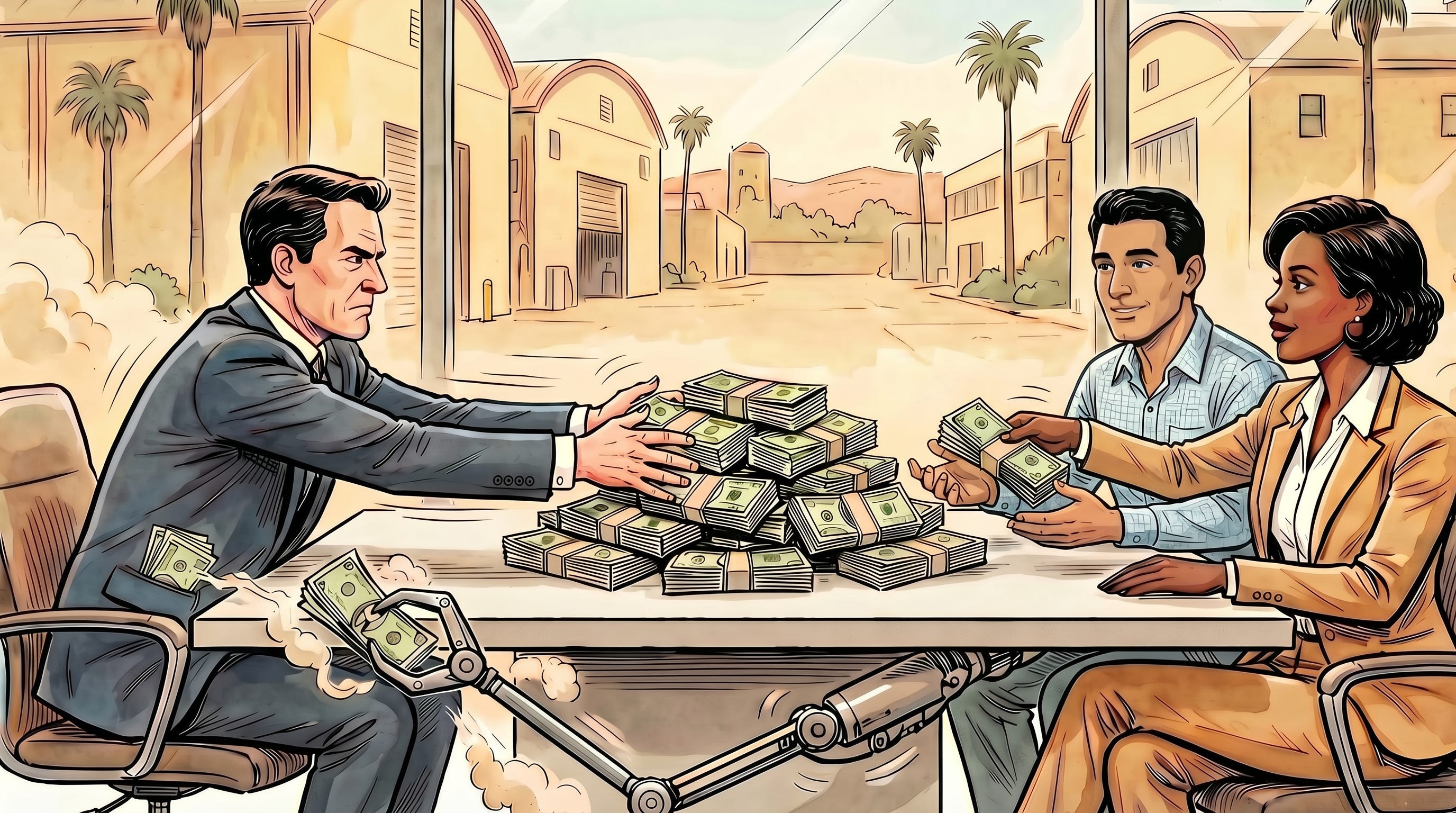
Bidding wars are where market-defining precedents are made and broken. At the outset of a negotiation, the two words that tell a dealmaker the most about how much (or how little) fun they’re about to have are “It’s competitive.” Aggressive competition for the most sought-after projects, talent, and IP during the industry’s “Streaming Wars” era (roughly 2013–23) upended decades-old dealmaking norms — with consequences that the industry is still reckoning with today.
Winning a bidding war can also be a transformative moment for a company’s future — but whether that’s for good or for ill depends on the deal. Netflix’s aggressive outbidding of its rivals for MRC’s House of Cards set the streamer on its path to dominance in original content production and exhibition. Vivendi’s acquisition of Universal in 2000, widely regarded as an overpay, led directly to the company’s near-collapse in 2002.
Hollywood just loves a good bidding war. And in today’s TV business, A24 — the prestige indie studio whose auteur-driven, aesthetically distinctive films have, in less than 15 years since its founding, earned the company unique and enviable cachet with critics1, investors2, filmmakers3, and audiences4 alike — wins a lot of them.
Last week, the Ankler’s Lesley Goldberg published a piece about A24’s disruptive impact on the TV business, with “fast deals and creator-friendly terms [that] make the studio a favorite among agents, and a headache for everyone else.” Goldberg addresses the question of “How A24 Wins Bidding Wars Beyond Money,” crediting the studio’s success to several factors, including its generous backends, creator-friendly development process, passionate advocacy with network partners, and willingness to contribute additional production funding and marketing resources to support its shows. And above all, she writes, “Speed is the separator.”
How to Really Win a Bidding War
Goldberg offers a robust answer to a very carefully framed question — one in which the words “Beyond Money” do a lot of heavy lifting. Because the main way that A24 wins these bidding wars is with money. Lots and lots of money.
A24 is one of a small handful of independent studios that seek to secure the most sought-after projects by intentionally and consistently offering well above top-of-market financial terms — seven-figure option fees, purchase prices that occasionally tack on an eighth digit, and pilot writing fees that compete with the highest-level feature scriptwriting deals.
That’s not to say that Goldberg’s reporting is inaccurate, or that A24’s creator-friendly practices — especially the speed and decisiveness she highlights — don’t matter. But while I’m sure writers, rightsholders, and their representatives love how quickly the offers arrive, I suspect it’s all the extra zeroes that really win those sellers over.
I also understand that Goldberg’s analysis wouldn’t have been as interesting or instructive had it just been her copying and pasting a gif of Mad Men’s Don Draper shouting “That’s what the money is for!” But while “money wins bidding wars” is about as exciting of a headline as “water is wet,” there is actually something very interesting — and frankly weird — going on here.

How Can David Afford to Outspend Goliath: With Goliath’s Own Money
To win the hottest projects on the market, A24 must outbid the likes of Netflix, Amazon, and Apple, companies worth roughly 100 to 1,000 times A24’s own (already dubiously inflated) value. How do they do it? With their rivals’ own money.
When it comes to TV studios, today’s buyer is tomorrow’s seller. While A24 is built to finance and produce original series, monetizing those series requires licensing them to a consumer-facing exhibition platform. In the modern market, that license will inevitably be on a “cost plus” basis — that is, for an amount equal to the full cost of production, plus $2 million per episode or more for a sought-after one-hour drama.5 And licensees routinely agree to reimburse seller studios’ out-of-pocket development expenses, in whole or in part, simply to acquire the exclusive option to order a series.
So when A24 agrees to these outsized financial terms to win a sought-after project, it does so knowing that, in success, the costs will be borne in full by some other (richer) company. Of course, it takes the risk that no buyer will step up to license the project, leaving A24 to absorb those costs itself. But A24 enters those situations knowing that at least some of those potential buyers have already signaled interest in the project — in their studio capacities, before losing the initial bid.
Viewed in those terms, A24’s willingness to write such big checks is easier to understand. But the whole thing gets weird again when you realize that, to earn any return on these investments, A24 must go on to sell its costly prizes to the very companies that it outbid to acquire them.
Why Streamers Agree to Rent Projects for More Than They Were Willing to Pay to Own Them
A streamer that loses a bidding war for a hot project, but goes on to buy that same project from the studio that defeated it, effectively agrees to pay more to license intellectual property than it was demonstrably willing to spend to own it.6 If that sounds crazy to you, imagine how offensive it is to the people at Netflix, Amazon, and Apple. And yet, it happens. Why?
The first explanation is simple and evergreen: this is a creative business, and what creative wants, creative usually gets.
Over the last few years, all of the major streamers have, with varying levels of conviction, sought to warn (and train) the market not to expect them to buy, as networks, the same projects that they previously tried and failed to acquire as studios. And each of the streamers has, at various times, explicitly cited having lost out in the initial bidding for a project to explain its unwillingness to make an offer to license it from the winning bidder.
But experienced business affairs executives are usually wary of trafficking in “always” and “never” statements, because they know that, when something shiny and appealing enough comes along, most so-called policies prove to be “more what you’d call ‘guidelines’ than actual rules.” And, as I’ve emphasized elsewhere: it’s a creative business, and whatever creative wants, creative usually gets.
Beyond realism about their own lack of dealmaking discipline, there’s a systemic reason for streamers to be wary of adopting too strict a policy here. The purpose of such a policy would be to gain leverage in its negotiations following that first round of pitches. But, because the universe of credible buyers for costly premium series is so small, agents are more likely to preserve the project’s long-term prospects by simply excluding any streamer with such a policy from that initial stage of pitches altogether.
To a streamer like Netflix, Amazon, or Apple, occasionally having to pay more than its own “best and final” offer for the rights to any given project is a galling annoyance. But being systematically excluded from the opportunity to make such bids in the first place would be a massive competitive disadvantage, both creatively and financially.
A Sane Strategy for Streamers to Bid Competitively in a Cost-Plus Market
So does that mean that, in order to secure their access to the initial marketplace for the most promising projects, streamers must tolerate occasionally spending more to rent those projects than they were initially prepared to pay to own them outright? Not necessarily.
If I were setting the rules at Netflix, Amazon, or Apple, I would apply a two-pronged policy to such situations.
First, I’d require that, if we lose out on the initial bidding for a project as a studio, we will only consider buying it as a network if it has been materially developed or enhanced beyond what we were initially given the opportunity to acquire — e.g., with a new pilot script written based on the initial pitch, or with an actor, director, or other new and material creative element added to the original package.
In theory, a creative package could justifiably be worth more because of such additions/developments than the same package would have been without them. And in practice, such a policy would discourage indie studios from hastily making crazy deals for hot projects in hopes of quickly and cynically arbitraging them without contributing significant effort and value.
And second, when making a deal to license a project from a studio that outbid us to acquire ownership and control of that project in the first place, I would require the seller studio to bear from its own profits 100% of the cost difference between the studio’s negotiated deal terms and our own highest bid for the same assets.
In other words, if A24 wants to sell to Netflix a project based on rights that A24 paid $2 million for, but that Netflix had previously offered only $1 million to acquire directly, I’d say A24 should expect to bear the full $1 million difference solely out of its own profit from the “premium” portion of Netflix’s “cost-plus” license fee (and not to pass that full cost onto Netflix as part of the budget of the licensed series).
This is, admittedly, a more complicated approach than streamers simply deciding to buy a project (and accept the terms that come with it) or not. And complication tends to prolong dealmaking, especially when a novel approach is first being introduced into the market — a pretty unappealing prospect for an industry that already justifiably bemoans the often glacial pace of dealmaking.
But that extra time and effort is worthwhile if it solves a real problem. And for the streamers, the current status quo — a binary choice between passing on projects they want (and potentially jeopardizing their own early access to the most promising projects in the future), or suffering the indignity (and bearing the cost) of being stuck with terms they already refused to agree to when they had the chance — is a problem worth solving.7
Moreover, there is good reason to be optimistic about the market’s ability to quickly integrate such terms into dealmaking for network license agreements: streamers are already using similar tactics to counter independent studios offering over-generous terms to actors when packaging projects before taking them to market.
While A24’s hyper-aggressive deal-making for rights and scripts is still somewhat novel, the same dynamics driving that behavior8 have also propelled the explosive growth of TV acting fees for over a decade. For at least half of that time, streamers have sought to disincentivize supplier studios from making overgenerous acting deals by (a) requiring the seller studio to disclose all of the major terms of the existing deals for the project before it will agree to close the license deal, and (b) sometimes refusing to recognize astronomical acting fees in the network-funded approved budget of a series, at least to the extent those fees exceed what the streamer would have agreed to — or at least what the streamer claims would be the most it would have agreed to9 — had it made a deal with that actor directly.10 In other words, what I’m proposing above isn’t so much a novel dealmaking practice as it is a logical extension of an existing one.
This post is always free, one of a handful that will never go behind the paywall. Share it with anyone.
A24 films won the Academy Award for Best Picture in two out of the company’s first ten years in existence — for 2016’s Moonlight and 2022’s Everything Everywhere All at Once.
In June 2024, Josh Kushner’s Thrive Capital invested $75 million into the company at an eye-watering valuation of $3.5 billion — roughly half of what David Ellison’s Skydance paid to acquire all of Paramount Global (including CBS, Paramount, and Viacom) just the following year. Consider me among the skeptics who question the legitimacy of this valuation.
Writing about the tension between A24’s indie identity and its pivot toward more commercial (and higher-budget) fare following the Thrive Capital investment, the New Yorker described A24 as having built an “Empire of Auteurs.”
It’s not an exaggeration to say that the phrase “A24 movie” is now practically a genre unto itself. Excluding brands built entirely around specific individual franchises (such as Marvel and Lucasfilm), I’d argue that the only other players in today’s market whose names convey similarly distinctive meaning to (and command similarly strong affection from) the general moviegoing public are Disney, Pixar, and Blumhouse. If we also consider TV, we can add HBO and FX to the list. And that’s it.
As I’ve written elsewhere, one of the unintended consequences of the “cost plus” license deal — which was developed to facilitate the ever-expanding (and eventually worldwide) territorial requirements of Netflix and Amazon — was to substantially sever the traditional alignment of interests between studios and networks and effectively disincentivize cost-conscious producing by studios. (See Chapter 2, Section B.ii and Chapter 3, Section C.ii of my book, and my September 2024 guest column for Matt Belloni’s What I’m Hearing newsletter.)
To better understand the distinct roles that studios and networks play in the TV/streaming industry (as copyright owners and licensees, respectively), as well as the complexities of affiliated studio/network relationships, check out Chapter 1, Sections B.ii–iii of my book.
To be clear, the nature of “cost-plus” licensing is such that, even with such limitations, a streamer still ends up worse-off (with respect to both rights and economics) buying the project from a supplier studio than it would have been producing the same project for itself with equivalent terms for creators and rightsholders. Even so, this compromise approach preserves a streamer’s opportunity to hear the initial pitches for hot properties and packages, while improving its prospects for securing those projects from inception by disincentivizing supplier studios from outbidding them too dramatically (lest those studios be left to foot the bill for their own excessive largesse).
These dynamics include a highly competitive marketplace, the general preference of platforms for projects they own and control over those owned by supplier studios, increasing pressure on studios to aggressively package projects with several major creative elements before pitching them to buyers, and the incentives created by “cost plus” licensing.
In reality, it’s not unusual for streamers to hold their studio partners to standards of dealmaking discipline that they don’t really adhere to themselves. To some extent, this is a matter of streamers overestimating their own toughness in negotiations, and not being honest and realistic with themselves about what they “would have” agreed to had they been in charge of negotiation. But it is also an intentional strategy that is meant to subtly but systematically incentivize the talent community to favor selling to and working for the streamers directly, rather than going through supplier studios.
In the past, this generally meant forcing studios to go back to the talent to renegotiate the offending terms as a condition of the streamer buying the project. Over time, however, streamers have grown increasingly concerned by the reputational consequences of this approach, given the tendency of studios to openly blame the mean, miserly streamers for insisting upon these renegotiations. As a result, it is now more common for streamers to specifically instruct seller studios not to renegotiate these deals, and instead reduce the premium portion of their license fee offers (i.e., the portion of the license fee that exceeds the show’s cost of production) by whatever amount the streamer previously would have asked to be clawed back from the offending deal.
A couple follow up questions:
1. Understood this is primarily TV, but in (theatrical) film where cost-plus is not the dominant licensing structure, then what changes/ improvements can be made there for indie studios?
2. Are there any remedies of the cost-plus model for serialized shows if the terms are locked in per-episode at the pilot/ order stage? The renewal negotiations become so adversarial because there are no shared upside - the studio wants to re-price up, the streamer already feels it overpaid.
3. Wouldn't an equity-like participation structure work better for indies in the long run?