


Ask any negotiator in the entertainment business what substantive topic they most hate dealing with, and you’re likely to hear one answer more than any other: backend.
Despite being one of the most critical and high-stakes topics in any negotiation, backend is also one of the least explained and most misunderstood. A disturbingly large percentage of dealmakers, even highly experienced ones, negotiate backend based on what someone once told them they were always supposed to ask for (or never supposed to give), without truly understanding the practical significance of any of it. Many negotiators can correctly tell you that A is better than B, but not why. Even those who truly understand all of the terminology and concepts often struggle to teach them to others; and when they try, even those who sincerely want to learn can quickly find themselves bored and lost.
I get it. Underneath all the jargon and legalese, backend is a formula: dollars go in, dollars go out, something is hopefully left at the end, and if so, your client gets a percentage of it. And none of us chose to go into entertainment, or to law school, because we were good at math. If we were, we probably would have gone to medical school like our mothers always wanted us to.
Too bad. Understanding backend is crucial to truly understanding how our business works; mastering backend is one of the things that separates the good dealmakers from the great ones; and really mastering backend means wrapping your mind around a wide variety of ways that it can work.
So join me on a field trip into the weeds, as I take you through a backend model that many TV negotiators have never seen, but all of them should know. That’s because, while it’s as traditional as you can get in the indie film world, it is quickly becoming a preferred tool of the innovators in the emerging business of “indie TV.” Not only that, it might be one of the most elegant solutions for any business context where the spoils of success must be allocated between those who contribute “cash equity” versus those who contribute “sweat equity.”
You might hear it referred to as “indie net points” or the “indie pools waterfall.” But I usually call it…
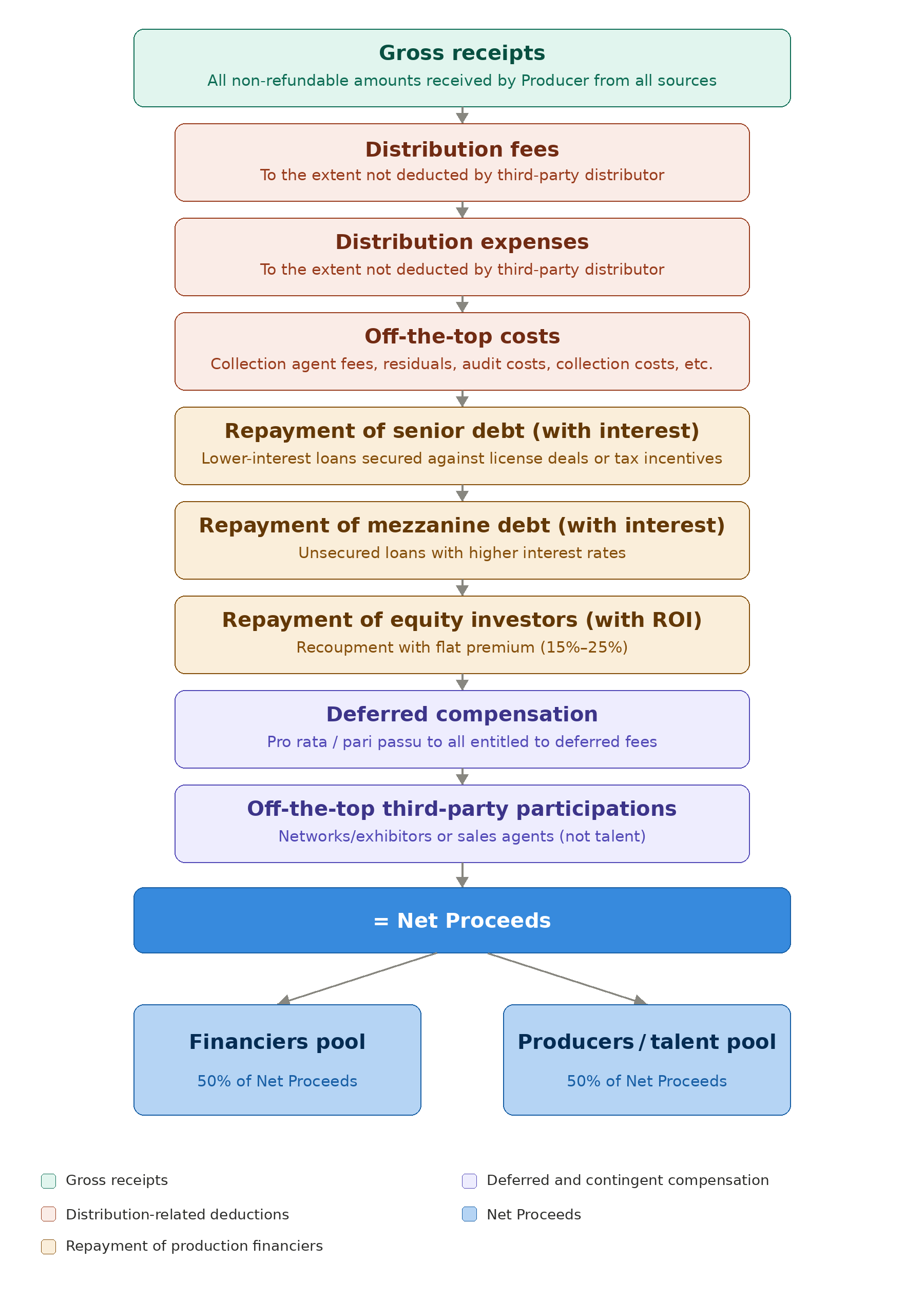
The 50/50 Pools Waterfall
Waterfall Walkthrough
Let’s walk this waterfall in a bit more detail, one step at a time. But before we dive in, a quick note about jargon. While I generally try to be sparing in my use of technical jargon (and conscientious about defining it when I do), this piece uses a lot of it (which the subject demands), usually without any explanation or definition (which readability demands). If you don’t know something means, try checking this site’s Glossary of Industry Terms (which I will also link to extensively below).1
With that out of the way, let’s dive in.
In the moment, I personally found it all to be a bit silly. But the guy had already successfully put together over 20 independent films by that point, including a few quite well-known and successful ones. And in the end . . . he was able to produce a roughly $5 million film with just $500,000 of his own money. After a well-received film festival premiere, he made a domestic distribution deal with a minimum guarantee high enough to put him into profit before the film was ever released. Shows what I know.
The rest of this post is for Paid and Premium subscribers. A subscription to The Business of Television Max opens the full site archives, as well as special articles and other professional resources available only to paying subscribers.