



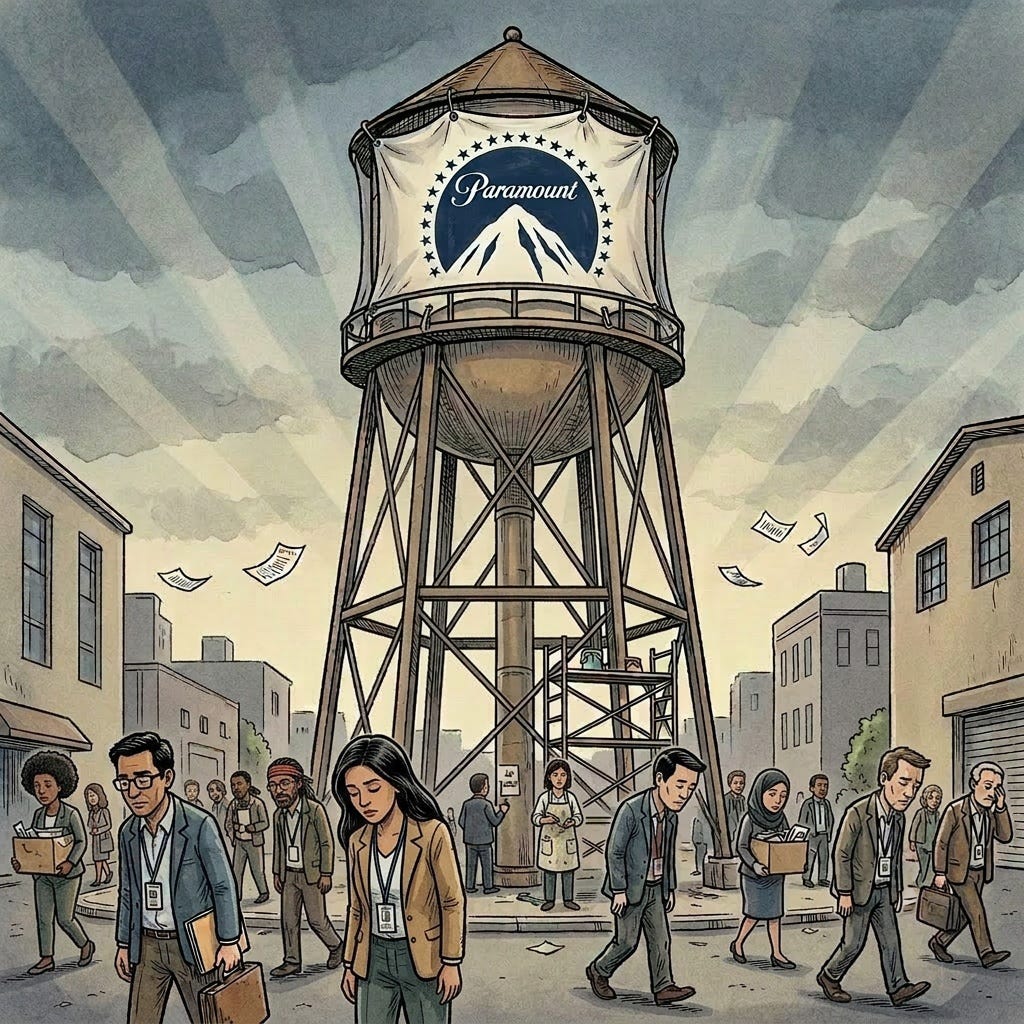
I have no idea if anybody is still working at Warner Bros. who started there before 1990. I doubt it. But if there is: (1) he or she probably works in some very practical, underappreciated, and likely blue collar position in studio facilities, administration, security, maintenance, or the like; and (2) if that person decides to retire in 2029 — almost certainly without a gold watch, but hopefully with some crazy old-school pension benefit that they somehow managed to hold onto for decades — then their 40-year career will have seen:
The merger of Warner Communications with Time Inc., forming a major media conglomerate with Warner Bros. as a division (1990);
Time Warner’s acquisition of Turner Broadcasting, including TNT, TBS, Cartoon Network, and CNN (1996);
The merger (2001) and de-merger (2003) of AOL and Time Warner (with AOL having gotten top billing in the deal);
One single glorious era of relative stability and continuity, if you don’t count the spinning off of assets like Time Warner Cable and Warner Music Group (2004–18);
AT&T’s acquisition of Time Warner and renaming of the company as WarnerMedia (ugh), an epically unsuccessful (if mercifully brief?) escapade about which the New York Times would eventually ask, “Was this $100 billion deal the worst merger ever?” (2018);
AT&T’s spin-off of WarnerMedia into a merger with Discovery, creating the Warner Bros. Discovery that just languished strategically and financially for years until suddenly becoming a hot commodity (2022); and
The Paramount logo replacing the Warner Bros. shield on the iconic water tower on the Burbank lot.
I’d love to say that, for the employees of Warner Bros., maybe Paramount could prove to be lucky number seven? But I’ve never understood why people claim that seven is a lucky number, when it’s the roll that loses you control of the dice in craps.
For The Business of Television Max’s debut week, I’ll be taking on the story that most of us are already talking about anyhow: Paramount’s victory in the most protracted and exasperating will-they-or-won’t-they corporate courtship since Skydance bought Paramount just a few years ago. And to celebrate this launch, I’m making it a four-part series (after which I hope to never talk about this subject, or write another four-part series about any subject, ever again):
In Monday’s Part 1, I gave a short answer to the question “Is this a good deal for Paramount?” (and a much longer answer to the question “Does it even matter?”).
In Tuesday’s Part 2, I looked at this deal in the context of Hollywood’s abysmal track record with mega-mergers, and considered what it will take for Ellison to succeed where so many others have failed.
In yesterday’s Part 3, I explained why this outcome is a still a win for Netflix — and how they managed to rig the situation so that pretty much any other outcome would have been too.
And finally, in today’s Part 4, I wrap up by exploring what this deal means for everyone else who didn’t have a seat at the bargaining table (and for one person who did).
To The Employees of Warner Bros. Discovery: I’m Really Sorry but This Is Going to Suck
Like most things in business (and life), the benefits and burdens of this deal will not be distributed equally or equitably. And there’s no great mystery about which group will bear the brunt: the employees of Warner Bros. Discovery.1
I opened this four-part series on Monday with these lines:
For months now, as Netflix and Paramount have competed for the privilege of wildly overpaying for Warner Bros., industry insiders have wondered and debated which deal would be “better” or “worse” for Hollywood as a whole, and which suitor would ultimately come out on top.
The first question is an extremely complex and nuanced one with no easy or obvious answer (though asking which would be “less bad” or “more bad” might be a more honest framing).
I still don’t know whether Netflix or Paramount winning the bidding war would have been "better” for the health and interests of the industry as a whole. I could make a case for either (although, for what it’s worth, the Daily Mail says Tom Cruise has no doubt). But I think I do know which option most of the employees of Warner Bros. Discovery preferred (and I agree would probably be better for their health and interests). It wasn’t the one they got.
The rest of this post is for Paid and Premium subscribers. A subscription to The Business of Television Max opens the full site archives, as well as special articles and other professional resources available only to paying subscribers.