


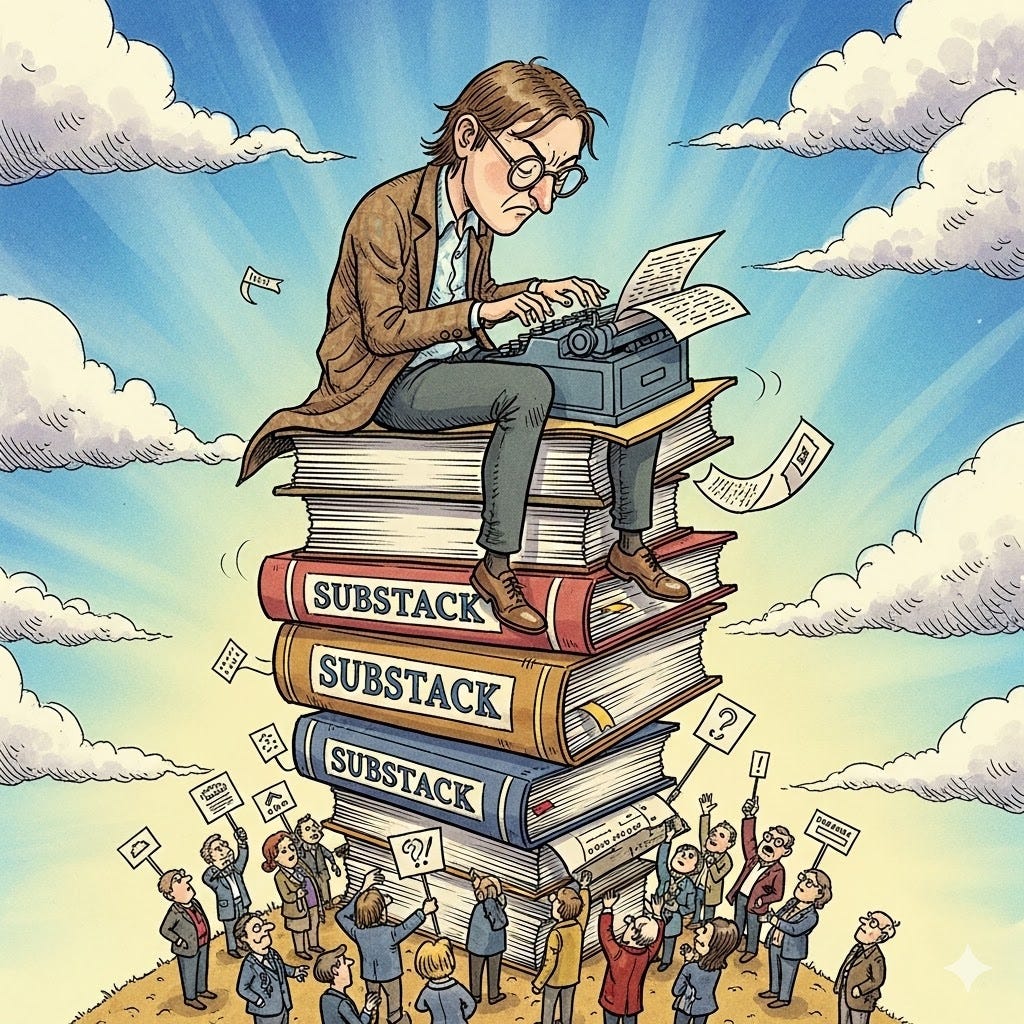
Since The Business of Television was first published in 2018, many friends and colleagues have asked me how and why I chose to take on the task of writing the book in the first place.1 Over the many late nights spent preparing to launch this site (and days with a delightful and energetic two-year-old sometimes dropping by and giving me a look that screams “why are you still on that computer?”), the question has taken on renewed salience for me personally.
This site’s About page makes the case for why The Business of Television Max offers something useful and distinct from the many existing purveyors of industry-oriented news, analysis, and hot takes that have emerged over the tumultuous last few years. And in the months ahead, I hope to offer you analysis and advice that is as sophisticated, insightful, and helpful as you can find anywhere. But I intend to deliver it in a voice — my own voice — that is more casual, more personal, and, yes, sometimes a bit angrier than you’re likely to find in most other high-quality publications (including my own book).
That’s because I am not here to play the role of dispassionate journalist or detached academic; I am here as an active and concerned member of the community for and about which I write. More specifically, I’m here as a nerd who has spent my entire career working hard to “make it” in this business, grappled mightily with the question of whether I should continue to stick with it, and experienced its travails every bit as deeply and personally as (I assume) you have. I am anything but “dispassionate” or “detached” about this stuff.
And so, for my inaugural post, I want to tell you a bit more about how The Business of Television first came to be, how my thinking about the project evolved for the book’s second edition, and why I decided now was the time to finally make it an ongoing part of my day-to-day life (and, if I’m lucky, the lives of others in my own professional community) — by launching this Substack.
2012: Learning the Basics for the Boss
The seeds for the book were planted in 2012, when I was called upon to negotiate my first big TV deal…for the Boss himself, Tony Danza, to executive produce and star in a good ol’ fashioned multi-cam sitcom that ABC Studios wanted to develop for their sister network, ABC.2
After working out the highest-level substantive points (largely over the phone), we began negotiating a full term sheet for the deal, which ABC Studios required to be confirmed as final before calling the deal “closed” and approving the project to be pitched to prospective buyers (starting with sister network ABC).3 It soon jumped out at me that, although many of my asks/comments were being accommodated in one way or another, several were drafted as being “Subject to ABC approval.” “But wait,” I thought to myself, “ABC sent me this offer. Why would a proposal from ABC be subject to ABC’s approval? Doesn’t the fact that they’re offering it necessarily mean that they’ve approved it?”
And that’s how I first learned the difference between a studio and a network.
My Kobayashi moment with ABC Studios/Network took place almost four years into my career as an entertainment lawyer. Because my work up to that point had been focused pretty much exclusively on feature films — Danza’s was perhaps the third TV deal of any kind that I had ever worked on — I could forgive myself for not knowing everything I needed to know. But that didn’t mean I felt comfortable revealing my confusion about something so fundamental-seeming to the partners I worked for (let alone to the client or his other reps). I decided it would be best to figure this one out for myself.

So I did what any good nerd would do: I immediately bought and read every “business book” about TV that I could find, hoping to build the foundation of knowledge I’d need to avoid such confusion and negotiate more confidently in the future. But I quickly found myself disappointed by everything I read — it all seemed too general, too focused on subtopics that were irrelevant to my work, and/or too hopelessly out-of-date to be of any use.
2018: A Gift to My 27-Year-Old Self
I never planned to write a book. But in 2014, I became an adjunct professor at Harvard Law School, where I taught Entertainment and Media Law for six academic years. Being a Harvard Law professor helped get me hired as a consultant by a fast-growing multi-channel network (or “MCN”) to prepare its business and legal affairs executives for the company’s upcoming pivot toward developing and producing serialized short-form digital series that looked a lot like what one might call “television.”4 The take-home summaries I created for my MCN client, together with the lecture slides and other materials I developed for my classes, became the outline for a chapter about scripted television dealmaking that I agreed to contribute to a friend’s planned reference book for legal practitioners. Before I knew it, one chapter had metastasized into two — one about scripted television dealmaking, and another explaining everything I thought a reader would need to know about the basic structure and function of the TV/streaming business to fully understand the other chapter.5 And it was only after I finished those chapters that I realized I was already about 40% of the way to an entire book (and that the existing chapters could be repurposed into a book proposal to secure a publishing contract before I committed to writing the other 60%).
In the end, that book — The Business of Television, published in 2018 — was a gift to my 27-year-old self: the book I was looking for (but never found) when I was learning the basics of the business on the job (and was too nervous to ask the “stupid” or “obvious”-seeming questions that came up along the way).
2024: Building a Shared Reality
When I first prepared to start working on the book’s second edition in late 2021 (planning for a January 2023 release), I expected it would be a relatively quick and straightforward task. All I needed to do was update the numbers/ranges for the current “Peak TV” market, remove or replace now-outdated pop culture references, revisit my old descriptions of the “current” state of the industry and predictions for its “future,” and boom: second edition.
I didn’t write a word for over two years.
It took me weeks of active introspection (and a few good conversations with my therapist) to figure out why. I had adopted my initial vision for the second edition because it seemed easy, fast, and obvious. What it did not seem was especially interesting for me to write, or important for others to read. I recognized that the book needed an update after five of the most dramatic and transformative years in the industry’s history, but felt preemptive guilt for asking people to pay a second time for a book they (mostly) already owned.
Inspiration struck in unusual form: the 2023 WGA and SAG-AFTRA strikes. In the months leading up to and during the summer of 2023, it seemed like nobody in the business could think or talk about anything else. But despite the deluge of “news,” “analysis,” and “discussion” that emerged to meet that demand, the conversation online mostly reminded me of the last words of MacBeth’s famous “Tomorrow and tomorrow and tomorrow” soliloquy: full of sound and fury signifying nothing.

As negotiations dragged on and the rhetoric on both sides heated up, voices espousing nuanced, constructive views were often drowned out, if not driven out of the conversation altogether for fear of enflaming one noisy constituency or another.6 What the industry needed was an intellectually curious and empathetic discussion, grounded in mutual recognition of the legitimate grievances and concerns on both sides of the table, and knit together by a shared understanding that all of us in this business — whatever “side of the table” we were nominally on — would either flourish together or suffer together in the years to come. What it got was a noisy and hostile shouting match, constrained by zero-sum thinking, in which complex issues were flattened into poisonously oversimplified ideological narratives and both sides often seemed more concerned with “winning” than with “solving important problems.”
The misery of 2023 inspired me to aspire to more for my book’s second edition — to make it not just a practical tool for young professionals like my 27-year-old self, but as a platform to try to build a shared understanding of how and why our business “worked” for as long as it did, what we lost in our chaotic collective shift toward streaming, and how we might hope to get some of it back. I delved into the tumultuous recent history of the prior decade, shared more of my personal experience and observations as a working dealmaker, and gave myself permission to occasionally (and transparently) describe things not just how they were (or had been), but also how they could (or maybe should) be in the future.
When it was finally published in September 2024, the second edition of The Business of Television was literally twice the length of its predecessor, and about half of the material carried over from the first edition had been substantially rewritten.
I am not here to play the role of dispassionate journalist or detached academic; I am here as an active and concerned member of the community for (and about) which I write.
2026: Trying to Have Fun Again
To be clear, working in this business has certainly never been easy. The defining feature of the entertainment industry labor market has long been a gross disparity between supply and demand — that is, many fewer jobs than people who want them — which both served as a barrier to entry and helped create and sustain many of the industry’s notorious and enduring ills.7 And it always seemed like every few years, someone would stand up and yell “Change places!,” setting off a sudden cascade of lateral moves, promotions, firings, and retirements that reset the corporate landscape (until, inevitably, someone again stood up and yelled “Change places!” and the whole process would repeat).
But the juice felt worth the squeeze. With a lot of hard work, support from a few key mentors and patrons, and a little luck, it still felt conquerable. Disruption was as chaotic as it was inevitable, but could also bring opportunity.8 As tough as it was to break into the business, once you did, you could usually look forward to a long, varied, and pretty satisfying career, which would provide you with great stories to tell at cocktail parties for years to come.
The disruption and destabilization of the industry over the last few years — especially the wave of corporate consolidation that has both resulted from and exacerbated that destabilization — have had profound personal as well as systemic consequences. At times, it can feel like the industry’s professional community can be divided into two groups: those who hate their jobs, and those who wish they still had jobs to hate.9 Every day, it seems a little bit harder to experience (or even remember) the energy and excitement that got us into this business in the first place. It’s still a game of musical chairs, but one in which no one feels safe to stand up (or even join the game) because someone suddenly swiped a lot of the chairs off the floor, and no one at any level seems to be having much fun anymore.10
Better professional development and support, as I aspire to offer here, can’t bring back the fun by themselves, let alone solve the big, structural challenge facing the industry. But, in addition to the goals described on the About page, this Substack — along with the new training/coaching venture that I’m launching alongside it — was born of my belief that they can make those challenges a little easier for the human beings who collectively make up this industry to bear.
In any discipline or era, the confidence and pride that come with a well-earned sense of mastery of one’s craft are their own reward. And, at least for us negotiators, that sense of ease and self-assurance, coupled with a healthy dose of humility, can feed into as well as flow out of the underlying mastery — a virtuous cycle in which competence and confidence create intellectual and emotional space for mutual creativity, generosity, and prosperity in dealmaking.
In troubled times like these, though, I believe that true command of one’s professional craft — and the enriching experience of receiving the support necessary to achieve it — can do even more for us. It can provide a modicum of comfort and reassurance in the face of persistent uncertainty and insecurity. It can remind and focus us on what we’ve gained from our careers, rather than dwelling on what we seem to have lost. In short, it can make good work days a little better, and bad work days a little less bad. And for most of us, that is just about the same as saying it can make the good days in life a little better, and the bad days in life a little less bad.
As anyone else who has ever written an extremely niche business book could tell you: it sure as hell wasn’t for the money.
As a rule, I will avoid identifying any specific individuals or companies (especially clients) or projects that are the backdrop or inspiration for my posts. I’m also going out of my way not to identify the name of this project or anyone else involved with it, even though you could probably figure it out easily enough with some quick Googling. But I’m making a special exception by mentioning Tony by name here because (1) Tony’s name really adds some wonderful color to the whole thing, doesn’t it?; (2) Tony is a lovely human being who I really think would be amused and delighted by this; (3) the substance of his deal (and any other information that could be considered remotely confidential or proprietary) is totally irrelevant to the story; (4) I’ve already told this story privately to nearly all of the individuals who were actually involved at the time; and (5) I’ve since learned enough to be confident that, despite my inexperience at the time, in the end, Tony’s interests were not harmed and he got the strong-in-every-way deal that he deserved. But please forgive my stylistic flourish in referring to Tony as “the Boss.” As we all know — and was conclusively proven by Abed Nadir, portrayed by Danny Pudi, in season 2, episode 20 of NBC’s Community — Anglela Bower was the Boss.
If you’d like a perfect illustration of how major media companies can be bafflingly, agonizingly slow to adapt to change: in 2012, as a matter of policy, ABC Studios still exclusively sent term sheet offers/drafts by fax (which, by that time, were automatically converted by my firm’s servers to PDF and delivered to my email inbox).
Ahhhh, MCNs…remember those? They were discussed at some length in the book’s first edition in 2018, but warranted little more than a couple passing mentions on a single page in the book’s second edition in 2024.
These first appeared in 2018’s The Essential Guide to Entertainment Law (or EG2EL).
You know, the exclusionary culture of dues-paying and nepotism, the excessive tolerance of abusive behavior, the tendency toward decision-making grounded in fear rather than vision…shall I go on?
Or, as a wise man once said, in a very different yet hauntingly familiar context: “Chaos is a ladder.”
I also could have gone with “those who fear losing their jobs, and those who already have.”
Or, as another wise man once said, in another very different yet hauntingly familiar context: “It’s good to be in something from the ground floor. I came too late for that, I know. But lately, I’ve been getting the feeling that I came at the end. The best is over.”