


On Friday, reflecting on the WGA and AMPTP’s unexpected early announcement of a tentative deal for a four-year extension to the WGA Basic Agreement, and with the just-ended Passover holiday, I likened the quick and drama-free closing — a stark and welcome contrast to the experience of 2023 — to the angel of death1 passing harmlessly over our homes this year.
As dramatic as it may seem to invoke the tenth biblical Egyptian plague to describe an unexpectedly peaceful outcome in what is essentially a routine triennial process, if you followed the hot mess of the 2023 collective bargaining season as closely as I did — and if you’re reading this, you probably did — it felt earned. For those fortunate souls who didn’t spend that summer making themselves miserable, I re-published the first of three posts I wrote for the Ankler that summer as the “Anonymous Business Affairs Exec.” And, to celebrate 2026’s markedly less hostile and poisonous vibes, I officially removed the “Anonymous” part.
Today, I’m kicking off my long-promised Ask the Author series, in which I’ll (usually) be answering questions and taking on topics requested by readers. But for this first installment, I’m doubling down on 2026’s (comparative) non-toxicity by doing one of the dumbest things you can do on the Internet — responding to criticism from anonymous commenters.
And while at it, I’m doubling down on Passover references too — this time, by addressing these (mostly) anonymous commenters as the “Four Sons” of the Passover Haggadah (the traditional Jewish text used for seders), in which four brothers of varying moral and intellectual character ask their father to explain the traditions of Passover in distinctly different ways.
The Wise Son
In the Haggadah, the “wise son” demonstrates his wisdom by asking his father about Passover traditions in a way that includes the son himself as part of the community he seeks to better understand.
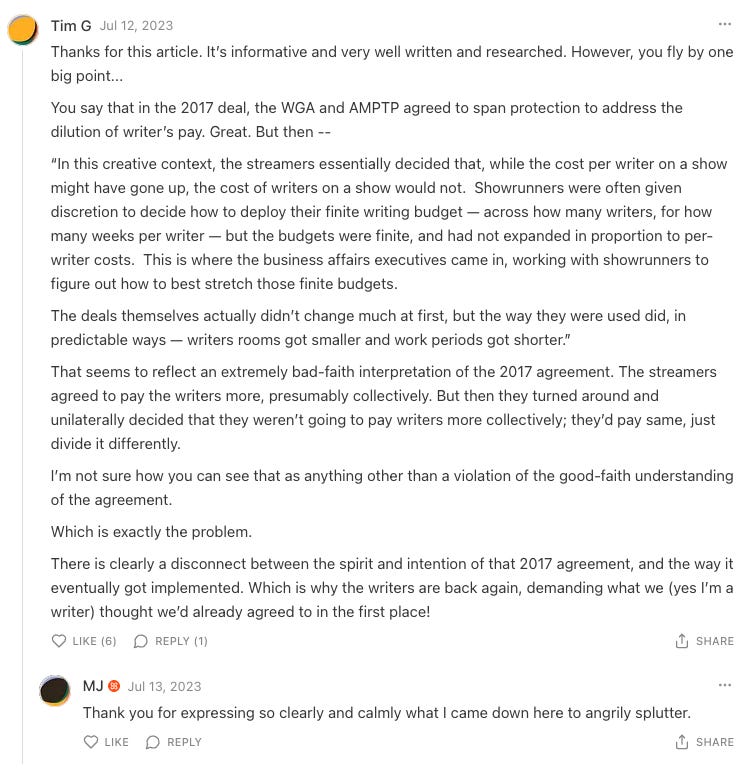
Tim earns the “wise son” designation by disagreeing with me in good faith, without accusing me of bad faith, and by treating us as members of the same community with common interests.
And he raises a fair point, as far as it goes. There was a disconnect between the spirit of the 2017 span protection provisions and the way studios deployed them — I’ve said as much myself. But his argument rests on a premise that “presumably collectively” quietly smuggles in: the idea that the WGA Basic Agreement is meant to operate as a guarantor (or at least a driver) of ever-increasing aggregate revenue flowing to the writers as a class. It isn’t, and it never has been.
Rather, while the WGA Basic Agreement may sometimes have the power to move market realities, it is first and foremost a response to them. It is an instrument of power-balancing to set default rules of engagement — a vehicle by which thousands of individuals can pool their leverage to achieve outcomes that, given those realities, most of them could not hope to achieve acting on their own. And in my view, the beneficiary of the WGA Basic Agreement is each of those individual writers, not the profession as a whole.
It also matters because, once you understand the purpose of the WGA Basic Agreement as I’ve described it above, the studios’ behavior looks less like bad faith and more like an entirely predictable institutional response to cost pressure. And, crucially, one in which no individual business affairs executive had the power — or, honestly, the incentive — to resist that logic unilaterally.
So I agree with Tim that there was a meaningful gap between the spirit and collective implementation of the 2017 “span protection” rules (that the writers can very reasonably be mad about). But if you believe — as I do, for both conceptual and pragmatic reasons stated above — that the people implementing those rules owed a duty solely to the writers in front of them (and not to the profession as a whole), then as much as we might bemoan the implementation, we can’t condemn it in moral terms.
The Wicked Son
In the Haggadah, the “wicked son” shows his wickedness by asking his father to explain Passover in a way that holds himself separate and apart from the community that he is asking about.

Matt’s comment beautifully illustrates why I couldn’t attach my name to the pieces I published in 2023, even though they were conciliatory in tone, granular in substance, and about as “both sides have a point” in spirit as you can get: people were goddamn crazy.
This isn’t what a person who is trying to solve a problem, persuade a counterpart, or even just get back to work sounds like. It’s what it sounds like when a person is so committed to the “us-vs.-them” dynamics of the moment that they can’t see who their allies are (or realize how they sound to normal people).2
Whereas “wise son” Tim G. accurately quoted my words to support his arguments, “wicked son” Matt “paraphrases” me with misleading quotes which are designed largely to set up his big finish, presumably because he is not familiar with Godwin’s Law3 (and therefore doesn’t realize what a sad — and, reading this in 2026, actually fairly offensive — cliché he’s being when he attempts to factually or morally equate studio dealmaking with Nazi genocide).
Matt is the wicked son not because his anger is illegitimate — writers got squeezed, and anger about that is earned — but because he ignores the complexity of the situation he’s angry about so that he can hold himself apart from, and direct that anger toward, a blameworthy foe. He’s not asking to understand, nor even to be understood. He’s asking to be enraged.
The Simple Son
The “simple son” of the Midrash asks his father “What is this?” — a question that represents the son’s unsophisticated but sincere curiosity.
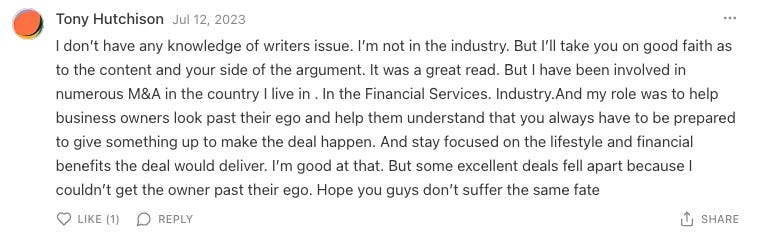
Tony is our simple son, and I mean that affectionately. He opens with a candid admission that he has no industry knowledge, extends good faith anyway, and then reaches across countries and industries to offer the only lens he has: corporate M&A dealmaking in financial services. It doesn’t quite fit — a guild contract negotiation and a business acquisition are structurally different things — but the impulse is genuinely collegial, and the “ego” remark is both salient and charming in its observational confidence.
For what it’s worth, Tony: 2023 was, at least in part, a process of overcoming those egos, but 2026 seems to be an example of what’s possible when they don’t get in the way. We can count that as progress.
The Son Who Does Not Know How to Ask
Finally, there is the “son who does not know how to ask,” who is included to emphasize the Torah’s commandment to tell the story of the Exodus even to those who cannot ask to hear it. The obligation of transmission is unconditional.
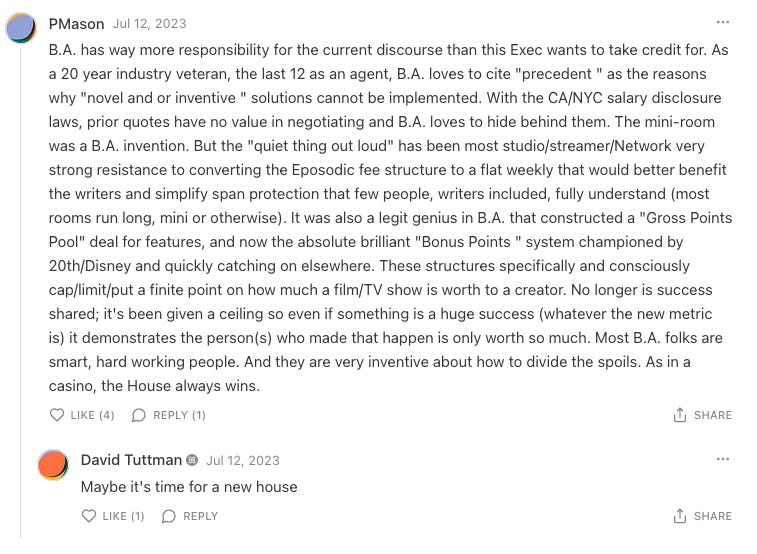
I recognize that the “Four Sons” framework starts to strain here. PMason is not uninformed or incurious — this is someone with two decades in the industry who has clearly watched the BA function up close, formed real views, and seems to be operating in good faith. The problem is the misplaced certainty.
PMason condemns resistance to weekly compensation structures, but even at the time he was writing (in July 2023), weekly deals were becoming increasingly common. Today, in 2026, weekly deals are relatively common, as are hybridized episodic deals that involve separately stated weekly rates for extended (e.g., beyond 52 weeks) and/or post-production services. He misunderstands the purpose and impact of the 2017/18 laws that prohibited employers from inquiring about a candidate’s salary history while negotiating terms of employment (which were intended primarily to counter the persistent gender wage gap across industries).4 He repeats the commonly held belief that Disney replaced traditionally calculated contingent compensation with its “Series Bonus Exhibit” as a scheme to depress backend payouts — it wasn’t and it didn’t.5 And while I share PMason's disdain for reliance on “policy” or “precedent” as a freestanding justification devoid of context or rationale (and have also criticized it in my own writing6), studio over-reliance on “precedent” in negotiation is an annoyance — not a theory of the case for critiquing evolving dealmaking practices.
PMason sounds like someone who, in a better format than the Internet comment thread, would be willing and able to have a serious, good faith conversation with someone with a different perspective. I’m sure he knows how to ask good questions — he just needs to remember to do so. And I hope he is also the type to take his status here as the “son who does not know how to ask” as it is intended: not as a sign of any disrespect, but as an expression of my commitment to the bit.
This post is always free, one of a handful that will never go behind the paywall. Share it with anyone.
As explained on Friday, “angel of death” isn’t really the right term here, but it’s the one people will most easily recognize and understand.
It’s also what it sounds like when a person has watched too many legal procedural dramas and doesn’t know that the phrase is “malice aforethought.”
“As an online discussion grows longer, the probability of a comparison involving Nazis or Hitler approaches one.”
See Chapter 6, Section C.i of my book (especially footnote 17 about the “quote system” and its end).
See Chapter 9, Section A of my book (especially footnote 19 about Disney’s controversial rollout of its “Series Bonus Exhibit”). To be clear, backend (at Disney and elsewhere) is much less valuable than it used to be, but that’s a function of bigger industry-wide changes in how TV series are produced and licensed, which had already depressed the value (both theoretically and actually) of TV contingent compensation entitlements in the years preceding Disney’s adoption of the SBE.
See Chapter 13, Sections C.i and C.iv.