




Last night marked the end of Passover.1 And while schedule-conscious American Jews who prioritize convenience over convention (like myself) might have held their seder on any of the holiday’s eight nights, the industry’s Jewish professionals would probably agree that this year’s Passover peaked on Saturday, when the WGA and AMPTP unexpectedly announced a tentative deal on a precedent-breaking four-year contract extension.
Only time will tell if the newfound sense of labor harmony around town — so welcome in an industry starved for any other kind — actually sticks. But for now, at least we can say that one of our industry’s triennial would-be Destroyers passed over all of our homes safely and peacefully this year.2 Special thanks to whoever remembered to put up the lamb’s blood on the studio gates!
My main reaction to Saturday’s news, after surprise, was relief — specifically, the relief of knowing that we apparently wouldn’t have to relive any of the frustration and misery of 2023. By July, over two months into the strike, the parties hadn’t even attempted direct talks for weeks, nor given any hint of what it would take to bring them back to the bargaining table. In the absence of productive dialogue, the vacuum was filled with a toxic Wall of Sound that would have made Phil Spector proud3 — blaming, kvetching, gossiping, trolling, and perhaps most of all, riffing.
Riffing on Twitter and in text threads! Riffing in protest chants and on picket signs! Friendly competitively riffing with friends, and hostile competitive riffing toward foes. A never-ending game of one-upmanship to determine who could make the funniest joke4, land the sickest burn5, or best project all of their own miseries, frustrations, and anxieties onto the other side.6 A cacophony of statements intended to energize allies, antagonize foes, and above all, gratify the speakers; but almost never to promote common interests or persuade anyone who didn’t already agree.
I wanted to try to contribute something useful to the public conversation, if only as a salve for my own frustration, anxiety, and (increasingly) boredom. I believed I had ideas that could be interesting and entertaining for the right audience — and, depending on how far those ideas traveled, maybe even valuable to the ongoing negotiations. But I also knew that, in the so-called “marketplace of ideas” of the Very Online crowd, nuance, compromise, and conciliation were all trading way down, while purity tests, adolescent trolling, and presumptions of bad faith were at all-time highs. In that environment, I was as wary of adding my name to the debate as I was eager to add my ideas.
My first contribution to the public conversation, published by the Ankler on July 12, 2023, was a wonky exploration of the origins of the much-maligned “mini-room” (and the role played by studio business affairs executives in its creation and institutionalization). The piece’s somewhat cringe/clickbait-y title — “Confessions of a Business Affairs Exec” — was selected by the Ankler’s editors (as is typical). But the choice of byline was mine.
The “Anonymous Business Affairs Exec” entered the chat.
I ultimately published three pieces under that byline, each of which seemed to be reasonably widely read and well-received. I occasionally heard second- or thirdhand that people actively involved in the negotiations on both sides had read and discussed the piece, though I have no idea if that’s true (and never tried to find out).
I never promoted my authorship, though I never denied it either. I received several calls and emails from friends and acquaintances asking if I was behind the pieces (and several more that simply assumed so and responded accordingly). And anytime someone asked me if I wrote the articles (or knew who did), I answered honestly. I simply never brought up the subject myself, and if people didn’t ask, I didn’t tell.
But the Anonymous Business Affairs Exec was a product of the unique (and uniquely miserable) environment of 2023. Another lesson I can take from Saturday? He isn’t needed in 2026.
That is why I’m rerunning “Confessions of a Business Affairs Exec” today, under my own name.7 Well, that and the fact that it makes a nice (low[ish]-effort) companion to Monday’s post — a celebration, as we look back, of how far we’ve come; and a reminder, as we look ahead, that the biggest problems of our present are often the unintended byproducts of our well-meaning solutions to the biggest problems of our past.
Another good reason to check it out? Because on Monday, I’ll be kicking off my long-promised Ask the Author series with a special follow-up to “Confessions of a Business Affairs Exec.” And, for the first time ever, I’m going to break my #1 rule for life on the Internet: I will publicly respond to anonymous Internet comments on my own no-longer-anonymous post.
Hope to see you then.
Confessions of a Business Affairs Exec
A top suit on how we got here, mistakes made and how we can help fix them
Published July 12, 2023

Like many of you, I have obsessively consumed news and analysis about this year’s (terribly-named) “Hot Labor Summer.” And as a longtime senior business affairs executive in Hollywood, my attention was especially piqued by a recent newsletter from The Ankler’s anonymous Entertainment Strategy Guy, titled “Business Affairs: Good Cop/Bad Cop of the Streaming Wars.” His thesis was pretty well captured in the lede: “The back engine that led us to a standoff also can get us out of it.” The back engine being… me. Us. The BA people.
I’m often a fan of ESG’s work, but my reaction to this particular piece can be summed up in two wistful words: I wish. That’s because, while ESG clearly has a solid general idea of what business affairs is and does, his analysis fundamentally (though flatteringly) misunderstands BA’s role in the industry generally, and its role in the collective bargaining process specifically. He gives us both more and less credit than we deserve. The road to the writers’ strike was paved with good intentions, but Business Affairs is neither the hero nor the villain of the story.
To my surprise, I found myself thinking about this article for days, and eventually, I realized why: because in this chaotic moment of upheaval and frustration in Hollywood, people are desperate to understand how we got into this mess and how we get out of it. They want to know who the villains are, and who might turn out to be heroes. And I believe ESG was right about at least one thing: understanding the role of business affairs in our ongoing industry-wide soap opera can teach us some valuable lessons about how we got here, and where we go from here.
In my piece, I want to offer the view from within the back engine about:
What power BA does (and doesn’t) have to make consequential decisions.
How BA created the mini-room — but not its unintended consequences.
How the industry solved the last structural crisis facing TV writers: pay dilution.
How BA works with showrunners to stretch a finite budget.
The role of BA in collective bargaining.
How span protection backfired.
What I think it will take to find a deal to get Hollywood back to work.
Whose Call Is It Anyway?
As ESG said, we make deals. That is absolutely true — and, for many BA executives, it is the thing they love most about their jobs. But I prefer a more abstract description that better captures what I love most about the job: we solve problems. Deals are our primary, but not exclusive, tool for doing so. And, as with many jobs, moving up the corporate ladder means going from the person who does the thing, to the person who decides how it gets done, to the person who decides what gets done in the first place.
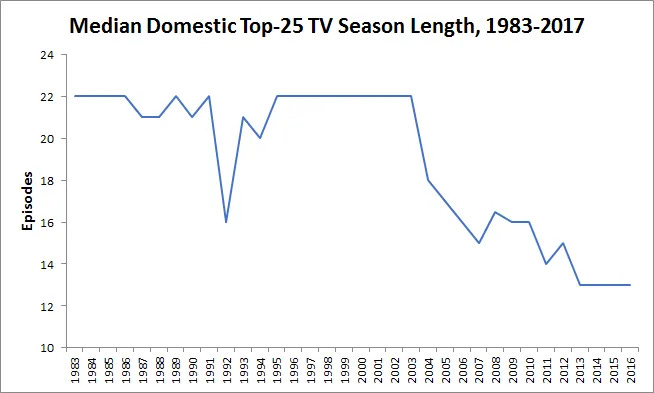
When the data showed that seasons with fewer episodes (which cost more per episode but less per season) were as effective as those with more episodes at attracting and retaining subscribers, orders began to shrink — from 13 to 12, to 10, to 8, and now to as few as 6 episodes per season.
But even the most senior and empowered business affairs executives do not set strategy and policy in a vacuum.8 Rather, our job is to find business solutions that deliver on the creative and strategic priorities of our creative leaders within the company. In the best circumstances, we work as a team with our creative counterparts, marrying our independent perspectives to arrive at good decisions. But at the end of the day, we know this partnership has its limits — to put it in the language of deals, even when we have mutual approval with our creative leaders, they get the tiebreaker.9
Beyond working to realize our creative leaders’ visions, BA executives also craft deals to satisfy the needs and demands of counter-parties (both talent and other companies) and to navigate the constraints of the marketplace. Many of us love to innovate, but when we do, it’s seldom to drive a vision of where we think the industry should go. (What a luxury that would be!) More often than not, we’re just doing our best to solve problems that are right in front of us.
Consequently, many of the business practices that are now at the heart of the WGA’s grievances were not (as ESG writes) “decisions” by business affairs executives so much as they were “reactions” — constrained by outside forces, more iterative than inventive, made in good faith to solve real problems, and often inadvertently giving rise to new ones. I could give you that backstory for every entry on ESG’s list of “most influential” BA-designed disruptions, but perhaps nowhere is it clearer than for the one that has most dominated the ongoing conflict between the studios and the WGA: mini-rooms.
The Rise of Mini-Rooms (or the Law of Unintended Consequences)
Of mini-rooms, ESG writes: “I can’t definitively say this is the brainchild of BA executives, but my gut is the rise of mini-rooms comes from business affairs executives pushing for cost cuts.” I can confirm that sentence is literally true; but it misses the real story entirely.
From 2014 to 2017, the biggest structural challenge to the TV writing profession wasn’t mini-rooms; it was pay dilution. Traditional writing deals, devised for the old world of 22-to-26-episode broadcast seasons, were based on episodic fees that were guaranteed for all episodes produced during a given production season.10 The only limitation on how long writers could be required to work for those fees was that their total compensation, divided over their total number of work weeks, had to exceed applicable WGA scale; the predictability of the broadcast calendar made further guardrails unnecessary. The rise of original programming on cable, which typically involved 13-episode seasons, put some strain on this system, but it remained essentially functional.
Then came streaming, which, at first, looked a lot like cable — 13-episode seasons on a regular annualized calendar. But as the streamers learned more about their audiences, they began to abandon many longstanding TV norms that they had initially respected. When the data showed that seasons with fewer episodes (which cost more per episode but less per season) were as effective as those with more episodes at attracting and retaining subscribers, orders began to shrink — from 13 to 12, to 10, to 8, and now to as few as 6 episodes per season. When House of Cards established complex serialized drama as the preeminent streaming genre, streamers — to the initial delight of creators and filmmakers — embraced longer writing and production periods that allowed for more ambitious shows, but made neatly annualized production and releasing nearly impossible. When customers went wild for Netflix’s binge releases, that became the new orthodoxy in streaming, even if it functionally extended unpaid hiatus periods between production seasons (and thus decisively made annualized production and releasing impossible).11 And as the Streaming Wars began to heat up, the streamers, unconstrained by programming calendars, came to dominate series production by virtually every measure.
Writers still received the same episodic fees they always had, but they received fewer and fewer of those fees, amortized over longer and longer work periods, with longer and longer unpaid breaks between seasons (during which they remained contractually on hold for a potential subsequent season). Because the only guardrail on the classic system of episodic fee deals was the weekly scale floor, within a few years, virtually all writers, from Co-Producers to Co-Executive Producers, were usually working for the same pay, regardless of their title or “on paper” compensation — weekly scale.12 Only the highest-paid creators and showrunners had fees large enough to remain north of scale when amortized over extended writing and production periods.
This became the dominant problem-to-be-solved of the 2017 negotiation between the AMPTP and WGA, which almost devolved into a strike until the AMPTP and WGA found their solution — “span protection.” For any deal made after May 2, 2018, an episodic fee would buy out no more than 2.4 weeks of work. Additional work time would be compensated at the rate of one additional episodic fee for every additional 2.4 weeks of work (prorated for lesser periods).
The problem of pay dilution was solved. The problem of mini-rooms was born.
The functional cost of employing a writer for as long as the studios typically had prior to May 2018 went up dramatically — indeed, that was the point of span protection. But the basic underlying economics of TV production and distribution hadn’t changed. Costs were already rapidly ballooning as streamers increasingly sought to outdo one another for star power and spectacle in an increasingly crowded marketplace. Shorter orders obviously required fewer scripts, and as shows grew more complex, they increasingly demanded more singular authorship than the episodic sitcoms and procedural cop/lawyer/doctor dramas of yore.
In this creative context, the streamers essentially decided that, while the cost per writer on a show might have gone up, the cost of writers on a show would not. Showrunners were often given discretion to decide how to deploy their finite writing budget — across how many writers, for how many weeks per writer — but the budgets were finite, and had not expanded in proportion to per-writer costs. This is where the business affairs executives came in, working with showrunners to figure out how to best stretch those finite budgets.
The deals themselves actually didn’t change much at first,13 but the way they were used did, in predictable ways — writers rooms got smaller and work periods got shorter.14 And because every network’s customary approval rights cover virtually all aspects of even an independent studio’s production plan and budget, down to the line-item level, streamers could enforce these new norms on licensed productions just as they did on their self-produced series.
For any deal made after May 2, 2018, an episodic fee would buy out no more than 2.4 weeks of work. Additional work time would be compensated at the rate of one additional episodic fee for every additional 2.4 weeks of work (prorated for lesser periods). The problem of pay dilution was solved. The problem of mini-rooms was born.
Studios and streamers compensated in part by relaxing once-standard requirements around options and exclusivity, which had restricted writers from taking other jobs, but the burden still fell upon the writers themselves to find more jobs — each of which was structured to these same new norms — to make the kinds of livings that they had before.
And as the years passed, the broader systemic consequences of these changes became clear. Junior and mid-level writers, working shorter periods on lengthier productions, lost the opportunity to develop experience as producers as well as writers. Writers jumping from job to job still got title bumps from season to season and deal to deal, but those bumps no longer reflected meaningful additional skills. As the skill sets of mid-level writers degraded, so did their ability to fully contribute to the creative and production process, further reinforcing and accelerating these trends. The fewer writers left to cover the entire production season worked to burnout levels to pick up the slack.
Which brings us to the mess we’re in today.
So yes, in a narrow sense, mini-rooms were invented “for cost cuts.” But they were not, as some especially aggrieved writers seem to believe, a nefarious plot to starve writers and undermine their profession. They were the unintended15 self-reinforcing backfire of studios trying in good faith to operationalize well-meaning new protections for writers, under heavy constraint from increasingly dominant streamers, who were themselves rapidly evolving the medium in response to new insights about viewer preferences.
Business Affairs in Collective Bargaining
It would be natural to assume that the folks that Hollywood generally entrusts with dealmaking would be leading the charge on negotiations that are as complex and consequential as the ones taking place between the AMPTP and the entertainment unions, especially given that they’ll also have to operationalize the new rules once these deals are finally done. But in reality — and much to the chagrin of many business affairs executives — BA has a surprisingly peripheral role in collective bargaining season, which is instead the triennial “time to shine” for the industry’s heads of labor relations.
To be clear, having these labor relations leaders (who generally report to the CEOs or general counsels, and not the heads of business affairs) at the center of the process is essential. The collectively bargained Master Basic Agreements (or “MBAs”) for SAG, WGA and DGA are barely comprehensible Frankenstein’s monsters, patched together with side-letters, popsicle sticks and bubblegum over decades of iterative revisions. Even the savviest business affairs executives typically know the MBAs only well enough to apply them in day-to-day dealmaking and/or production management. When faced with a novel or ambiguous situation that requires identifying and interpreting an MBA’s relevant provisions, BA executives tend to substantially rely on and defer to their colleagues in labor relations.
And it’s not that business affairs leaders don’t get any say in these negotiations. The AMPTP holds occasional conference calls in which the lead negotiators — again, the heads of labor relations — update their BA colleagues on the course of negotiations and get feedback on potential negotiating positions. Some heads of BA also cultivate close and collaborative working relationships with their counterparts in labor relations that afford them greater visibility and voice during collective bargaining season.
But at the very least, the impact of business affairs leaders on Hollywood’s triennial union negotiations is considerably smaller than most of the industry understands (and than most heads of business affairs would prefer). The heads of business affairs at the AMPTP companies negotiate high-stakes deals under often combative circumstances. They are responsible for applying the requirements of the MBAs in day-to-day dealmaking, and for devising new deal structures to adapt to changes arising out of each renewal. They spend their careers cultivating relationships and building trust with the industry’s community of agents and lawyers, as well as with key talent — especially showrunners. The best among them possess some of the industry’s finest business minds, and understand the deals they make and the context in which they make them on a deeply sophisticated level. Yet their role in setting the AMPTP’s negotiating strategy and devising specific proposed changes to the MBAs is secondary at best.
So What Now?
To offer a take that will anger everyone and satisfy no one: the grievances that have sent the writers to the picket lines (and that will probably send the actors out to join them as early as tomorrow) are real. So too are the financial pressures and existential uncertainties facing the AMPTP studios (especially the legacy ones). And both sides seem to have abandoned any presumption of good faith for the other, which makes finding common ground impossible. At least for now, everyone seems much more interested in making a point than in making a deal.
But there is a deal to be made here, because there are solutions to these very real problems. Finding them will require empathy, with both sides looking past each other’s positions to try to understand and address the concerns underlying them. It will require restoring a mutual presumption of good faith, and recognizing that we are ultimately all on the same team because we will all ultimately thrive together or wither together. It will require a whole lot of creativity, born out of a whole lot of practical experience, because these challenges are too big and too structural to fix with a silver bullet or with incremental tweaks at the margins. And it will require some humility, because as the story of mini-rooms demonstrates, even the best-intentioned efforts to solve major problems can accidentally give rise to new ones.
With all respect to our sometimes brilliant heads of labor relations, I wouldn’t say that all of the above is exactly their bread and butter. And I don’t expect the writers — who, to my endless frustration, have insisted on acting as their own negotiators (and as their own press agents too, unfortunately) — to independently crack those complexities any more than I expect studio executives to write great pilot scripts. I may be far from unbiased on the matter, but that all sounds to me like a job for business affairs.
Maybe I didn’t disagree with ESG quite as much as I thought.
This post is always free, one of a handful that will never go behind the paywall. Share it with anyone.
And with it, the end of my annual week of self-indulgent late-night Nutella-on-matzo snacking. Technically “fancy hazelnut-cocoa spread from Eataly”-on-matzo. I would defend that indulgence as being at least partially offset by the lack of leavened bread in my diet during Passover, but the truth is that I am a terrible Jew and don’t observe any kind of kosher rules, for Passover or at any other time.
Fun fact: the phrase “angel of death” does not appear in any biblical telling of the Passover story, but was developed in subsequent Talmudic scholarship, and largely entered the broader culture and lexicon of Passover (especially in the English language) in fin-de-siècle Europe (circa 1880–1910). [Disclosure: I knew “angel of death” wasn’t in any biblical text, but had to look up when it began to be used in place of “Destroyer” (or, sometimes, “destroying angel”) in common parlance.]
That is, had the legendary record producer and convicted murderer/noted nightmare person not died in prison of complications from covid-19 in 2021.
Some of the jokes were, indeed, pretty funny.
Some of the burns were, in fact, pretty sick.
I’m using a lot of “both sides” language here, but if we’re being honest, both sides weren’t equally enthusiastic (and well-practiced) about the noisy sloganeering. And if we’re really being honest, while I was generally aligned with the writers on the substance (if not the framing) of the issues, and deeply disappointed with the AMPTP’s general failure to engage seriously on the issues, I was even more off-put and alienated by the performatively hostile approach adopted by the WGA and enthusiastically “yes and”ed by so many of its members. Eventually, reading about WGA and AMPTP leadership occasionally sniping at each other in the press (rather than talking constructively in a private conference room) started reminding me of watching a baseball game between the Yankees and the Red Sox and rooting for a meteorite to hit the stadium.
Thank you again to my friends at the Ankler for signing off on this re-publication (and getting the Anonymous Business Affairs Exec’s message out there in the first place).
To ESG’s credit, he acknowledges that “development and business affairs work hand-in-hand” and that “everyone from accounting to content licensing to finance to strategic planning helps craft these deal terms.” But these provisos still leave out a lot about the context in which business affairs executives do their work, and how they make — or don’t make — major choices about how deals are done.
Consider this my response to ESG’s crediting of business affairs executives for “the boom in overall deals.”
More precisely, staff writers were customarily paid the applicable weekly scale under Article 13 of the WGA Basic Agreement; story editors typically received the higher weekly scale amount under Article 14.K; and executive story editors received Article 14.K scale + 10 percent. More senior writers — co-producers, producers, supervising producers, co-executive producers and executive producers — received episodic fees that grew as they moved up the ranks.
That said, I strongly personally agree with analysts — including ESG! — who argue that, avowed customer preferences aside, weekly releasing is actually better for business than binge releasing.
During this period, studios had to cut the customary “plus 10 percent” from executive story editor deals to avoid the awkwardness of lower-ranked ESEs earning more than higher-ranked writer-producers.
That said, over the years, the complexities of managing the span rules have led many studios to pivot away from episodic pay structures to weekly ones at all levels.
In most cases, writers would be required (or allowed?) to work for only as many weeks as their fees could buy out under the new span rules — e.g., 24 weeks for a 10-episode order, 19.2 weeks for an 8-episode order, etc. And because span protection didn’t apply to writers making $350,000 or more per season, I had more than one negotiation in which I offered a writer $35,000/episode for 10 episodes, and got a counter of $32,500/episode.
Just because a result is unintended doesn’t mean that it’s unanticipated, or at least, that it can’t be anticipated. And while I sincerely believe that the negotiators who devised span protection did not see the developments of the last five years coming, within a few months of its introduction in May 2018, some of us BA executives did, warning that it would inevitably lead to a generation of undertrained writer-producers and a looming labor crisis — and that the day-to-day realities of getting things done in the TV business would leave us powerless to stop that.