



My first post on this site was a mini-manifesto called “The Stubborn Idealism of Substacking,” in which I dedicated my efforts, here and in my concurrently-launched Prime professional training/coaching service, to the cause of helping people access the confidence and pride — and maybe even improved general sense of well-being — that come with a well-earned sense of mastery of one’s professional craft.
For the most part, I’m only qualified to try help people toward that goal whose professional interests and backgrounds are relatively close to my own as a TV studio business affairs executive, lawyer, and consultant. But my own success in those roles owes a lot to the generosity of the many colleagues in creative, finance, production, marketing, and other departments who have generously served as my tutors and phone-a-friends in their areas of expertise.
That’s why I also want this to be a forum to highlight inspiring examples, illuminating insights, and worthy role models of professional excellence from people I admire in fields other than my own. I’m calling this series: What Good Looks Like.
Today’s opening installment also doubles as an epilogue to Tuesday’s post, which sprang from an exchange between Ron Moore (Battlestar Galactica, Outlander, For All Mankind) and David Shore (House, Sneaky Pete, The Good Doctor) about their diametrically opposed preferences when receiving creative notes from studio or network executives. A key takeaway from that exchange was that neither was right or wrong — they just had their own ways they liked to work (which could be understood and adapted to).
So, for this first celebration of What Good Looks Like, it wouldn’t be intellectually honest for me to call what I want to share with you today “The Right Way to Give and Respond to Creative Notes.” But it is, without question, by far the finest example that you or I will ever be privileged enough to get to see so up-close.
You might remember Cinemax’s The Knick, a stylish and substantive Clive Owen period drama that was as critically acclaimed as it was criminally underwatched — including, if I’m being honest, by me, other than a few scattered episodes watched with (or over the shoulder of) my then-roommate, who could catch me up quickly and well enough for me to really appreciate the accomplishment of what I was watching. The show was canceled after its similarly outstanding second season in 2015 — which, I might add, premiered exactly one year after the prior season’s finale’s initial air date, in case anyone needs a reminder (other than The Pitt) that it is indeed possible to deliver continued excellence on an annual basis (and on a reasonable budget).
Less than a year later, then-HBO/Cinemax exec Kary Antholis, who led the Cinemax creative team that worked with writer/director/editor/cinematographer Steven Soderbergh, published on Medium the aptly named The Knick Notes: a series of unabridged and uncensored examples of Cinemax and Soderbergh’s real-life email correspondence during post-production of The Knick, giving and responding to Cinemax’s notes on cuts of every episode of the series.
They are, in short, extraordinary. The Cinemax team’s notes are specific and actionable without being overly prescriptive. They are spare but dense, and come off as both comprehensive and carefully-curated. And on the other side of the process, Soderbergh — who controls and personally executes virtually every aspect of the preparation of these cuts — delivers an absolute masterclass in how to take, adapt, deflect, or reject network notes. Somebody at the WGA or DGA, please get this guy to teach a class.
I find it amazing enough that Kary — for whom The Knick was just one in a murderer’s row of projects that he oversaw during his 25-year run at HBO and Cinemax (which I just linked to because simply listing them here could too easily come off as a sly attempt at advertising or flattery) — decided he wanted to try to publish this stuff in the first place. But I consider it almost miraculous that he got both HBO and Soderbergh on board with the idea pretty much immediately.
Now working as a writer and producer under his own Crime Story Media banner, the ever-affable Kary was just as supportive and decisive when I first approached him for his blessing to feature The Knick Notes on The Business of Television Max. (Thanks again, Kary!)
Below, I’m republishing the notes correspondence for Cut A of episode 101 of Cinemax’s The Knick — the series premiere. If you find it half as fascinating or inspiring as I do, then check out the complete Knick Notes for Seasons 1 and 2 (and know that you are in for a treat).
101 CUT A
1–2
As discussed, this is our most radical structural thought in the series: we suggest lifting this sequence and placing it at the end of the episode. We’ve discussed the intended effects (delaying our knowledge of Thackery’s addiction and propelling us into the next episode), and acknowledge that we may be trying to solve a problem that doesn’t exist and may be creating others. But let’s revisit the suggestion, after we have all had a night to reflect on its full implications.
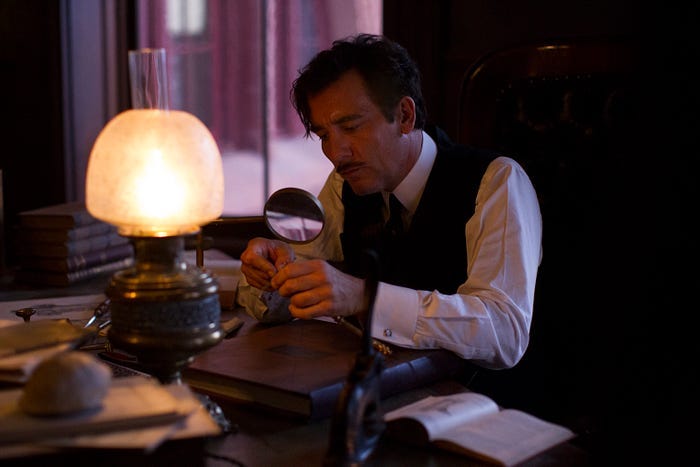
SODERBERGH: The primary reason for this note was an interest in saving a “reveal” of Thackery’s addiction to propel us into the 2nd episode, but in point of fact Lucy’s retrieval of Thackery for the Gentile surgery makes that idea unworkable. The real problem, to my mind, was a missing beat between Thackery leaving the hospital and then being rousted by Lucy, exacerbated by the confusion caused by Thackery leaving cocaine behind at the office and then having some on his nightstand at home.
SOLUTION: Cut Thackery pulling cocaine out of his bag and then leaving the office; steal scene of Thackery working late at night at home and flashing back to Christiansen introducing him to cocaine from episode 103 and place it between the two scenes of Lucy checking on Gentile at The Knick. By doing this, we imply that Thackery’s attempt to go without cocaine was instigated by this late night flashback. Snap! Please make check out to CASH!
1–10, 11
Can we tighten here, possibly cutting Nurse Monk up top walking around for prep and beginning with Thackery and Christiansen entering behind Lucy? Can we find trims and cuts to ratchet up the tension as the confidence of surgeons and spectators gives way to anxiety and eventually distress?
SODERBERGH: Trimmed head of scene as suggested. Don’t know how to make the surgery scene and more tense/intense, but I’ll keep looking at it.
1A-13, 1B-13
Can we tighten? Perhaps we can hold back on the reveal of the gun in the drawer and ease up on the score so Christiansen’s act lands as a shock?
SODERBERGH: Done.
1–13
Can we come into the funeral scene a beat later, perhaps on Thackery up at the lectern looking at Christiansen’s casket? Are there trims in the body of the eulogy?
SODERBERGH: Trimmed head of scene.
1–14
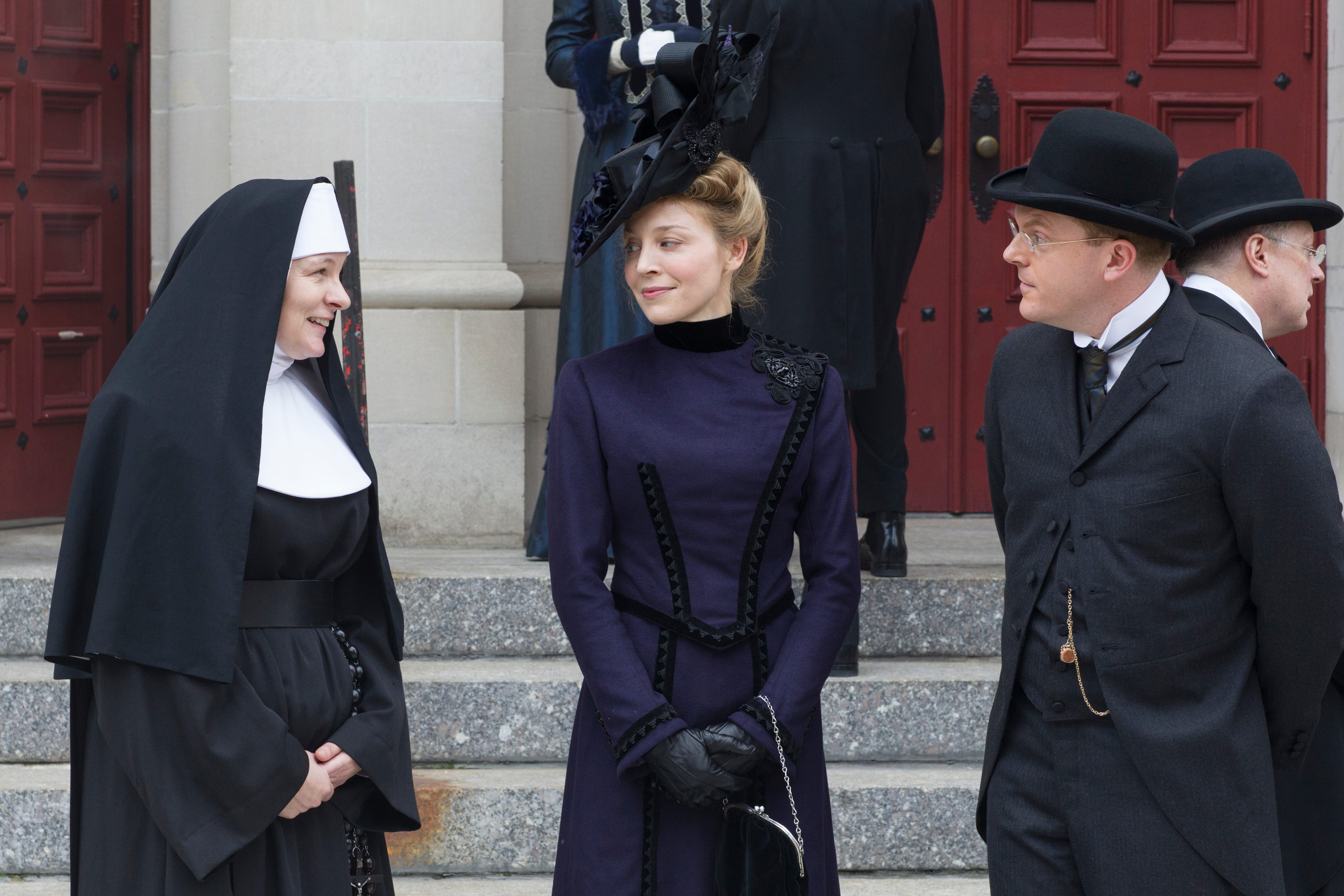

Any plans for score on Cornelia and Sister Harriet’s walk outside?
SODERBERGH: Not currently, for reasons of tone. If the music is too light (or in the “things are moving along” vein), it’s out of kilter with the fact we’re leaving a funeral; if it’s too heavy, it’s out of kilter with the dialogue, which is quietly sarcastic.
1-A20
Can we find trims in this boardroom scene?
SODERBERGH: Not really. Already cut 1.5 pages and this is information we need re: The Knick’s status and Algernon.
1–22
Can we cut this first orphanage scene?
SODERBERGH: Done.
1–27
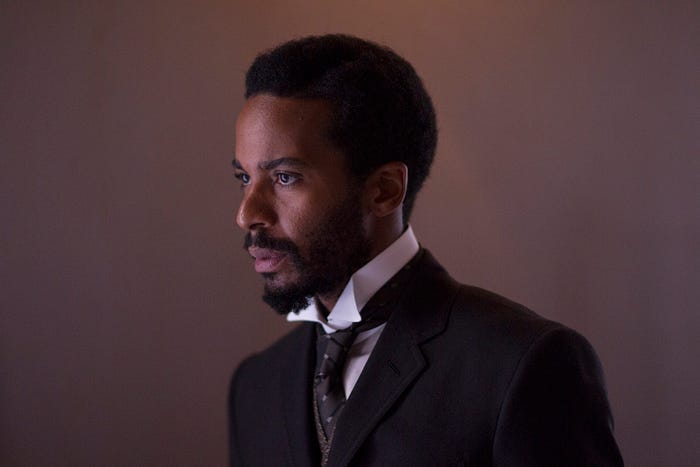
Can we cut Algernon’s, “you envisioned something different, something lighter,” and Thackery’s response, “I did”?
SODERBERGH: Not sure why we would cut that exchange, but I tried it and it resulted in a very awkward transition in the dialogue.
1–29
Can we find trims here? Perhaps cut from Speight’s line, “good looking family…” to “where did you get those patients…”?
SODERBERGH: I like that stuff; it’s good character detail re: Speight’s values.
1–31
Can we trim Bertie’s ministrations here, possibly even start out on Bertie and Cornelia’s conversation in the hallway: “I don’t think she makes it through this week”?
SODERBERGH: Done.
1–33
If we decide to hold back the knowledge of Thackery’s addiction until Lucy finds him and end with Thackery shooting up in the carriage, can we cut Thack dumping the vials into his drawer?
If we don’t make that change, can we make clear that Thackery is deciding not to use here, i.e. see his face? We are aware we may well not have it, but can we cheat his face from somewhere else? Additionally, this scene raises the question of what Thackery’s point is leaving the vials in his office since he has cocaine in his apartment that we later see Lucy shoot him up with.
SODERBERGH: See first note.
1–36
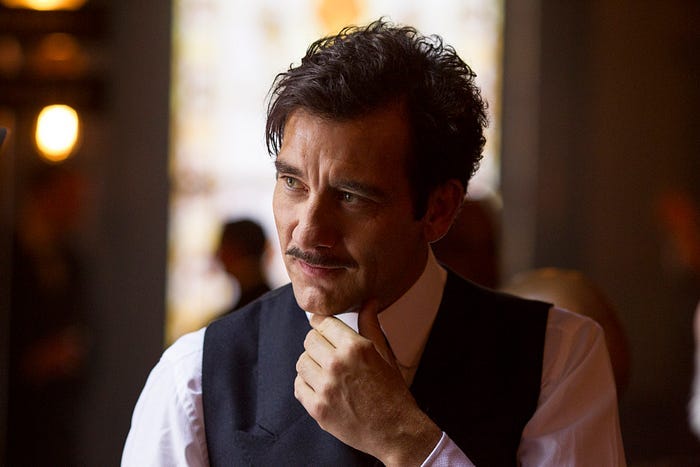
The jump cut from day to night threw us slightly. Can we can just show the day piece of the scene and cut Lucy’s discovery at night that Gentile is getting sicker?
SODERBERGH: See first note.
1–38
Can we trim Algernon’s reaction to Barrow’s pronouncement?
SODERBERGH: Not sure which reaction you mean.
Given Gentile’s later racist comment, is it peculiar that he is not recoiling at being touched by Algernon?
SODERBERGH: Agreed. I’ve cut Gentile’s comment in this scene.
1–39–1–42
Can we use jump cuts here to advance the urgency? Get Lucy to Thackery’s bedroom quicker? Can we play this whole sequence more frantic and frenetic and get into the act of Lucy shooting Thackery up quicker?
SODERBERGH: Done.
101 MUSIC
Thanks for taking the time to chat this morning. As discussed here are a couple of final music notes for episode 101.
Under the board meeting, perhaps a version of the heartbeat from the final episode board meeting.
SODERBERGH: Tried that, but it’s a little too foreboding considering the content of the meeting, and we don’t want to rob that final scene of its dramatic weight. We’ve also got a completely scored scene immediately following, so scoring the entire boardroom scene isn’t really an option. What I DID do is to put a transitional piece between Cleary getting the phone call and Thackery waiting in the boardroom just to give a sense of going somewhere.
Perhaps rather than thinking of our suggested cue as a “typhoid theme” we can think of it as a “public health theme” which might go under Speight inspecting the tenements or talking to the German slumlord. Also under the Chickering-Cornelia scene regarding the tuberculosis patient.
SODERBERGH: Think I found a piece from later in the show that could work as a typhoid-type theme. Trying it under Speight’s first appearance and at first Hemming house scene.
This post is always free, one of a handful that will never go behind the paywall. Share it with anyone.
I love this! It was refreshing to read the back and forth between two creatives at the highest level. These conversations sound like the ones I have with my editor and sound designer. I, naively, thought Soderbergh and those of his ilk were just born geniuses and didn't have to do this type of back and forth to get the scenes right. Its an unvarnished look at the final"writing" of an episode as they reframe moments for better impact. Thanks for this.